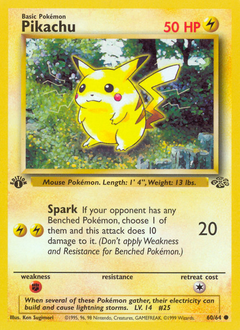
1st Edition Jungle Pikachu 60/64: The Only One
Reviewed by Caleb Stapel · Collector · Updated September 2026
For the entire Wizards of the Coast era, Pikachu appeared in exactly one regular set besides Base Set — and this is it. Every other Pikachu of the period was a promo, a League card or a trophy. That structural oddity is why a common from the second expansion carries a real following: it is the only ordinary Pikachu the era ever printed. Raw copies trade around $25.49, while a PSA 10 gem has cleared $1,275.00.
This page covers the 1st Edition version specifically. Jungle has no Shadowless tier, so the stamp is the whole test — the 3-second check below settles it.
| Grade | Market Price | Share of graded copies |
|---|---|---|
| Ungraded (raw) | $25.49 | — |
| PSA 7 (NM) | $49.50 | 12.4% |
| PSA 8 (NM-MT) | $78.00 | 24.6% |
| PSA 9 (Mint) | $141.75 | 33.3% |
| PSA 10 (Gem Mint) | $1,275.00 | 13.0% |
| Grade 6 or below | — | 16.7% |
Prices: PriceCharting sold-comp data, September 16, 2026 — refreshed monthly. Comps move; verify current sold prices before transacting.
Live Now on eBay: 1st Edition Pikachu
What the card is actually being offered for right now. Every listing below is filtered to the genuine genuine 1st Edition version — no repacks, mystery slabs, card skins, or multi-card lots. These are asking prices, not sold comps, so treat them as the top of the market rather than what copies are changing hands for.
Loading current listings…
Which One Do You Have? Identifying a Jungle (1999) Card
Jungle was the first expansion set after the Base Set, released in 1999. Unlike Base Set it has no Shadowless printing — it went from 1st Edition straight to unlimited — so a Jungle card is either stamped or it is not.
- Set symbol: a flower/Jungle symbol in the lower-right of the art box.
- Left of the art box: a black “Edition 1” stamp = 1st Edition. No stamp = unlimited.
- No shadowless exists: Jungle skipped the shadowless step entirely, so “no stamp but no shadow” simply means unlimited here.
Jungle 1st Edition is the scarce half of the set. The unlimited print is the one most childhood collections hold, and the gap between them is steeper than in Base Set because the 1st Edition run was shorter.
 Click to enlarge
 Click to enlarge
The normal print and the reverse holo are the same card and the same number — the only difference is the foil. Prices above are PSA 8 sold comps from PriceCharting, September 2026.
About This Card and Set
Jungle is the first expansion the Pokémon TCG ever had, and it reached the US on 16 June 1999 on a schedule that had been moved forward. It was originally planned for later that summer, and Wizards pulled it in when it learned Topps was about to launch Pokémon cards of its own. The set then sold out within two weeks, into the middle of Pokémania — a May 1999 card show in New Jersey drew more than 13,000 people, and stores were rationing. The Jamboree of that year is well documented elsewhere on this site; Jungle is the set that had to get out of the door first.
The English set is bigger than the Japanese original, and collectors have never fully agreed on why. Japan's Jungle had 48 cards; Wizards shipped 64, adding non-holo versions of all sixteen holo rares — by Wizards' own framing to stop every pack guaranteeing a holo, and by the contemporary complaint a way of inflating a set without adding anything. A third explanation circulates too, that it was a response to players unhappy about putting their holos into play. Two of those three are on the record and they are not reconciled.
What makes this particular card interesting is what it is not. The famous "extra" Pikachu in 1st Edition Jungle packs is the Ivy Pikachu — Wizards Black Star Promo #1, a completely separate card that carries the promo symbol and not Jungle's. Collectors have confused the two for twenty-five years, and the confusion is worth understanding because of what sits behind it: nobody has ever settled whether that promo was meant to be in those packs.
How Rare Is This Card?
The census here is one of the deepest of any vintage card, which is exactly what you would expect for a Pikachu common out of a set that sold out in a fortnight. PriceCharting records 11,002 PSA-graded copies of this card, of which 1,429 are PSA 10 — a gem rate of 13.0%. Nothing about that is scarce. The distribution is broad: PSA 9 is the largest block at 33.3%, and 16.7% of graded copies sit at grade 6 or below, because a $25 card got handled.
| Card | PSA 10s | Total graded | Gem rate |
|---|---|---|---|
| 1st Edition Jungle Pikachu #60 (1999) | 1,429 | 11,002 | 13.0% |
| Skyridge Pikachu #84 (2003) | 189 | 655 | 28.9% |
The useful comparison is not against modern cards but against the rest of the Wizards era. Skyridge's Pikachu gems at more than twice this rate on a population seventeen times smaller — because by 2003 the hobby graded what it pulled, while a 1999 Jungle Pikachu went into a deck. The scarcity on this card is not in the card. It is entirely in the top grade.
Both standing caveats apply. Graded counts are submission tallies, not unique cards — resubmissions inflate them — and the census is a floor that grows with every submission wave.
Known Error Cards
This card itself has no known error. It does not appear in the misprint community's Jungle documentation, and its variants are about printing and distribution rather than mistakes. That is worth saying plainly, because Jungle gets a reputation for being error-heavy and almost all of it belongs to other cards:
The set's famous errors are holos. An early Unlimited run of the sixteen Jungle holo rares shipped without the set symbol and was later corrected. Every 1st Edition non-holo Electrode used Base Set artwork instead of its own — a mistake never fixed within that run, which turns the wrong picture into an edition marker. Every 1st Edition holo Zapdos carries a stray non-holo rectangle in the top-left where nothing should be. Butterfree and Clefable have documented misprint variants of their own. None of those are Pikachu #60, and none should be attributed to it.
Two things that look like errors and are not. Jungle has no Shadowless printing — it went straight from 1st Edition to Unlimited — so a "Shadowless Jungle Pikachu" is a misidentified card or a fake, and the phrase turns up in listings anyway. And the Australian "Red Logo" release, where the word Pokémon printed in red rather than yellow, is a packaging variant of the same cards; collectors openly dispute whether it was an anti-counterfeiting measure or a printer's necessity, and both stories are on the record.
The Artist
Ken Sugimori illustrated this card — and he is the one artist in the hobby whose involvement needs no justification. He is a founding member of Game Freak and the company's art director, he finalised the original 151 Pokémon designs, and he has drawn more Pokémon TCG cards than anyone alive.
The artwork itself is older than the card. Sugimori painted this Bulb-adjacent Pikachu for the Japanese Jungle release in March 1997, and the English card reused it in 1999 — a two-year gap that is invisible on the page. If you want to know what Sugimori was solving when he drew Pikachu at all, his own recorded reasoning is that he chose yellow because it is the colour attribute of electricity, and that the cheeks were inspired by squirrels. The character was designed by Atsuko Nishida; Sugimori finalised it.
One honest note the artist databases make: there is no interview in which Sugimori discusses this specific illustration. We looked. What exists is his general account of the design, which is worth having and is different from a per-card story.
🎨 Coming: the artist value rankings
Caleb's Collector Verdict
Who is this card for? Pikachu collectors, and there is a real population of them — master-checklist collectors list Jungle 1st Edition as its own slot, separately from the W stamped promo and the Unlimited print. Beyond that it is a strong affordable vintage card: Sugimori art from the second set, from a run that sold out in two weeks, for the price of a meal.
What it is not is scarce, and it should not be sold to anyone as if it were. Eleven thousand PSA-graded copies is a deep census, and the raw card is genuinely easy to find. The entire premium sits at PSA 10, where the population is 1,429 and the spread between a 9 and a 10 is roughly nine times. A mid-grade copy of this card is a collecting pleasure, not an investment.
Honest strengths: the only regular-set Pikachu of the whole Wizards era, Sugimori art, a set with a genuinely good story, and one of the lowest entrances in vintage. Honest trade-offs: a common card with a common's census, a premium concentrated at one grade, and constant market confusion with the Ivy Pikachu that has nothing to do with this card.
People Also Ask
Is my Jungle Pikachu real or fake?
Pikachu #60 is not in the heavily-counterfeited tier. The identification problem on this card is different: because Jungle has no Shadowless printing, the Edition 1 stamp is the only thing separating a 1st Edition from an Unlimited copy — and stamps do get added. The rule is that a genuine stamped card never carries a drop shadow on the art box. Full checks in How to Spot a Fake Pokémon Card.
Should I grade this card?
It clears the fee at every grade, but the maths is thin until the top. Raw is around $25.49 and a PSA 7 around $49.50 against the $59.99 PSA Standard cost — so a 7 roughly breaks even at best. A PSA 9 at $141.75 is where it starts to work, and PSA 10 at $1,275.00 is the whole prize. Only 13.0% of graded copies reach a 10, and 16.7% land at grade 6 or below where the card is worth less than raw. It ranks #26 of 101 in Cards Worth Chasing. Use the grading guide and CardGrader scanner on your copy first.
Is the Pikachu in my 1st Edition Jungle pack an Ivy Pikachu?
It might be, and that is a different card. The Ivy Pikachu is Wizards Black Star Promo #1 — it carries the promo set symbol, not Jungle's, and it should not be filed as Pikachu #60. Whether it was meant to be in 1st Edition Jungle boosters has never been settled: a Japanese magazine advertised a rare Pikachu in the packs, and Wizards said at the time that it was a mistake. Both versions are still in circulation.
What is the W-stamped Jungle Pikachu?
It is this same card reprinted as a promo, with a gold W stamp near the set symbol, given away in the September 1999 issue of The Duelist. It is one of only seven W promos ever made. Note that the W stamp exists in English 1st Edition and Italian Unlimited — an Unlimited English W-stamped Pikachu does not exist.
Which printings of Jungle Pikachu exist?
Only two proper printings: 1st Edition (Edition 1 stamp) and Unlimited (no stamp). There is no Shadowless Jungle — the set went straight from 1st Edition to Unlimited, which is unusual for the Wizards era and is the reason the stamp is the entire identification test.