
Charizard 1st Edition Base Set: The Card the Run Existed For
Reviewed by Caleb Stapel · Collector · Updated September 2026
Charizard is the holy grail of the hobby and the single most recognisable Pokémon card ever printed. Raw copies trade around $9,606, while a PSA 10 gem has cleared $343,098 — the gap between those two numbers is the whole story of this card.
This page covers the 1st Edition printing specifically — the stamped, shadowless-stock version from the original January 1999 run. If you are unsure which of the Base Set Charizard printings you own, the 3-second test below settles it before you read any further.
| Grade | Market Price | Share of graded copies |
|---|---|---|
| Ungraded (raw) | $9,527 | — |
| PSA 7 (NM) | $18,605 | 11.6% |
| PSA 8 (NM-MT) | $25,673 | 13.7% |
| PSA 9 (Mint) | $28,241 | 14.0% |
| PSA 10 (Gem Mint) | $335,180 | 2.4% |
| Grade 6 or below | — | 58.3% |
Prices and population shares: the Cards Worth Chasing ranking, PSA only, September 2026. Shares are of all PSA-graded copies of this card, so they sum to 100% with the grade-6-and-below row. Grading cost basis $59.99 (PSA Standard). Comps move — verify current sold prices before transacting.
Live Now on eBay: 1st Edition Charizard
What the card is actually being offered for right now. Every listing below is filtered to the genuine 1st Edition card — no repacks, mystery slabs, card skins, or multi-card lots. These are asking prices, not sold comps, so treat them as the top of the market rather than what copies are changing hands for.
Loading current listings…
Which One Do You Have? The 3-Second Test
Most people who say “I have a 1st Edition Charizard from childhood” don’t. Retail packs in 1999–2000 were overwhelmingly Unlimited printing — and that’s fine, it’s the same iconic card. The fast check:
- Right edge of the art box: a dark drop shadow = Unlimited or 4th Print. No shadow = keep going.
- Left of the art box: a black “Edition 1” stamp = 1st Edition. No stamp + no shadow = Shadowless.
- Bottom copyright line: ©1999-2000 = 4th Print. A Poké Ball symbol beside the art box = Base Set 2 (2000), a different set (#4/130).
Click to enlarge
 Click to enlarge
 Click to enlarge
 Click to enlarge
 Click to enlarge
PSA 8 prices: PriceCharting sold-comp data, September 2026 — refreshed monthly. Unlimited and 4th Print look nearly identical — the copyright year is the difference. Each printing is its own card with its own price and history; see every printing: 1st Edition · Shadowless · Unlimited · 4th Print · Base Set 2.
About This Card and Set
When Wizards of the Coast brought the Pokémon Trading Card Game to North America on January 9, 1999, it landed in the middle of a phenomenon. The Game Boy games and the anime had arrived months earlier, and by spring, schoolyards had a single currency: a holographic Charizard. Card #4 of 102 in the Base Set, it was the chase card of the very first English print run — the one carrying the small black “Edition 1” stamp to the left of the artwork. Holofoil rares appeared roughly one per pack, and Charizard was one of sixteen of them, so pulling one was closer to a small lottery win than a purchase. Kids who got one traded it, showed it off, and very often wrecked it, which is exactly why pristine survivors are scarce today.
Collectors have called it the hobby’s “holy grail” for decades, and auction houses have long run with the “1952 Topps Mickey Mantle of Pokémon cards” comparison. Its media life did as much to secure that status as the pack odds did. Charizard was the franchise’s signature creature — created by Atsuko Nishida for Pokémon Red and Green, and the disobedient, eventual powerhouse belonging to Ash Ketchum in the anime, where it returned from the Charicific Valley to rescue him. For a generation raised on that, the Base Set holo was the creature in your own binder.
In the 2020s it crossed into an asset class. Gary “King Pokémon” Haase sold a PSA 10 1st Edition Charizard to Logan Paul for $150,000 in 2020; rapper Logic bought one that same month for roughly $220,000. Realised public auction results climbed from about $369,000 in 2021 to $420,000 in March 2022, then $550,000 in December 2025 — and, with a celebrity-provenance premium attached, $954,800 in February 2026.
How Rare Is This Card?
Start with the number that describes the whole card: roughly 6,120 graded copies exist in total, and ~124 of those are PSA 10s. That is a gem rate of about 2% — and the gem rate, not the raw population, is what a collector should actually be reading. High-grade supply is what the market pays for, and this card almost never produces it.
The PSA 9 tier holds about 680 copies. Set beside the other headline holos, that makes Charizard less scarce at the gem tier than Blastoise (101) — which is a useful reminder that the market prices the name and the iconography, not purely the census.
| Card | PSA 10s | Total graded | Gem rate |
|---|---|---|---|
| 1st Edition Charizard (1999) | ~124 | ~6,120 | ~2% |
| Charizard ex #199, S&V 151 (2023) | 29,679 | 102,490 | ~29% |
PriceCharting population data, September 2026. The modern row is a combined PSA + CGC count; the 1999 row is PSA, the way it is normally quoted.
Read those two rows together and the reason vintage works differently becomes obvious. The modern chase has roughly 240× as many PSA 10s as this card, and gems at fourteen times the rate. A modern card can be submitted in bulk within weeks of release; a 1999 card was printed before grading was mainstream and then spent two decades in a binder. A hundred vintage gems is not “more common” than a modern card with tens of thousands — it reflects a print run nobody was slabbing for the first twenty-five years, and a card the graders rarely see in this condition at all.
Two caveats stay attached to every population figure on this site. Graded counts are submission tallies, not unique cards — crack-and-regrade resubmissions inflate the total, so the number of genuinely distinct gem copies is lower. And the census is a floor, not a final number: it grows with every submission wave.
Known Error Cards
The stamp itself is a story. The 1st Edition Base Set carries two versions of the “Edition 1” mark — a “thick” stamp with a wide “1” and a “thin” stamp — and collectors have argued for years about which came first. The strongest argument runs that thick came first, because every WOTC 1st Edition set after Base Set used the thin stamp while thick exists only in Base Set. It is a reasonable inference, not a proven fact: Wizards never documented the sequence. A third variant, the “grey” stamp — from ink that was low or had not fully dried — turns up across the set. All three are 1st Edition variants.
The famous Base Set Charizard error is not. The “Black Dot Error” — a small ink dot over the “t” in “Nintendo,” with a visible holo-shift and holo-bleed — appears on Unlimited copies only, and is labelled as such by both PSA and CGC. The square-cut “Disco” holofoil test prints, authenticated by CGC in 2022, come from uncut test sheets — not 1st Edition cards.
What Makes This Card Collectible?
Charizard is the single most wanted card in the hobby — the object against which every other vintage card is priced.
- The #4 is not a rank. It is the alphabetical position of “Charizard” among the sixteen holos — an ordering artefact the hobby has learned to read as prestige.
- Original Arita art. Drawn for the card rather than reused, and the illustration that made Arita’s name in the TCG.
- The stamp is the subtype. Thick, thin and the rare grey 1st Edition marks all trade within the same label — set-builders chase thick for uniformity.
- Condition rarity on top of print rarity. At roughly a 2% gem rate the scarce object is not the card but the card in the condition it was never collected in.
Plenty of collectors will never own a 1st Edition copy, and this page will not pretend otherwise. If you own any 1999 Charizard — even the Unlimited one from a childhood binder — you own the hobby’s most recognisable object; the Base Set hub shows where that copy sits against the other three.
The Artist: Mitsuhiro Arita
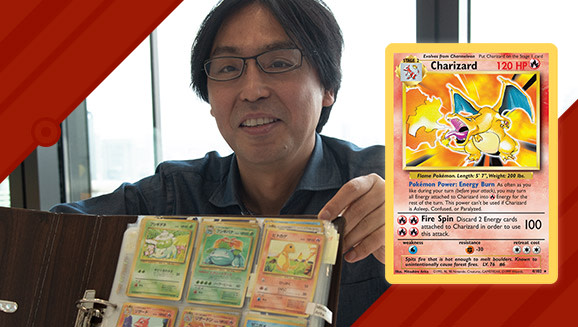
Mitsuhiro Arita (b. 1971, Fukuoka) was a fresh freelance illustrator when Pokémon became his first professional project in 1996, and he has drawn for the TCG ever since. His Charizard — wings flared against a wash of flame — remains the single most recognised illustration in the hobby. He has said the early team had no art director and worked from Game Boy sprites, inventing their own backgrounds; of the card’s fame his only thought is that he is “glad people don’t say that the quality of my artwork was so low since I designed it at the beginning of my career.”
Photo: Pokémon.com creator profile — read the full interview.