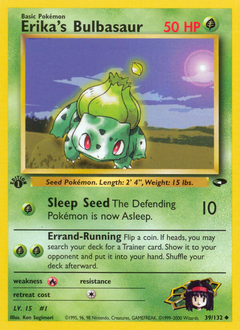
1st Edition Erika's Bulbasaur #39: Art from 1996
Reviewed by Caleb Stapel · Collector · Updated September 2026
Erika's Bulbasaur looks like an ordinary uncommon from an overlooked set. It is not. The artwork predates the card by four years — it descends from a prototype Bulbasaur drawn for a 1996 CoroCoro promotion, and its forest background is a crop of the same CG woodland used on Base Set Ivysaur. The Bulbasaur family were all painted against one modelled forest, from different angles. Raw copies trade around $38.21, and a PSA 10 gem has cleared $530.23.
This page covers the 1st Edition version specifically. Gym Challenge has no Shadowless tier, so the stamp settles it — the 3-second check below does that.
| Grade | Market Price | Share of graded copies |
|---|---|---|
| Ungraded (raw) | $38.21 | — |
| PSA 7 (NM) | $28.66 | 8.3% |
| PSA 8 (NM-MT) | $43.32 | 26.4% |
| PSA 9 (Mint) | $92.95 | 37.2% |
| PSA 10 (Gem Mint) | $530.23 | 20.6% |
| Grade 6 or below | — | 7.6% |
Prices: PriceCharting sold-comp data, September 16, 2026 — refreshed monthly. Comps move; verify current sold prices before transacting.
Live Now on eBay: 1st Edition Erika's Bulbasaur
What the card is actually being offered for right now. Every listing below is filtered to the genuine genuine 1st Edition version — no repacks, mystery slabs, card skins, or multi-card lots. These are asking prices, not sold comps, so treat them as the top of the market rather than what copies are changing hands for.
Loading current listings…
Which One Do You Have? Identifying a Gym Challenge (2000) Card
Gym Challenge is the second Gym set, continuing the Trainer-owned Pokémon line. Lt. Surge's Pikachu appears here again, with different artwork and its own numbering.
- Set symbol: a Gym Challenge symbol in the lower-right of the art box.
- Left of the art box: a black “Edition 1” stamp = 1st Edition.
- No shadowless printing exists for the Gym sets.
Gym Heroes and Gym Challenge both contain a Lt. Surge's Pikachu. They are different cards with different art and different numbers — check the symbol before comparing prices.
 Click to enlarge
 Click to enlarge
The normal print and the reverse holo are the same card and the same number — the only difference is the foil. Prices above are PSA 8 sold comps from PriceCharting, September 2026.
About This Card and Set
Gym Challenge is the set that arrived at the worst possible moment. It launched on 16 October 2000 — one day after Pokémon Gold & Silver reached North America, the biggest game launch of the year. A 132-card expansion built entirely around the Kanto Gym Leaders looked instantly dated next to a brand-new region, and players moved on to Johto. The consequence is still visible in supply: Gym Challenge was opened less than the sets on either side of it, which is the single biggest reason its cards are scarcer than their print run suggests.
The "owner's Pokémon" concept was the set's whole idea. Every card carries a Trainer's name with their headshot and Gym Badge in the corner, and the layout changed to fit it — no Pokédex flavour text, and the weakness and resistance stacked to make room. It did not go over well. Owner's Pokémon had to be evolved from the same owner's Pokémon, which players disliked because it killed mixing cards across sets, and by 2000 standards most of them were considered weak. That is the mechanism behind this card's modern scarcity, and it is a neat irony: the cards people binned are the cards people now chase.
The two-part structure matters too. Gym Heroes covered the first four Leaders — Brock, Misty, Lt. Surge and Erika; Gym Challenge added Koga, Sabrina, Blaine and Giovanni. There is no Gym Heroes Erika's Bulbasaur. The English card exists only in Gym Challenge as #39, and listings that call it a Gym Heroes card are mislabelling it.
How Rare Is This Card?
This is the thinnest census of the five cards in this batch, and the rate is the highest. PriceCharting records 277 PSA-graded copies, of which 57 are PSA 10 — a gem rate of 20.6%, the best of the group. The distribution leans late: PSA 9 is the largest block at 37.2%, and only 7.6% sit at grade 6 or below. Cards from this set were opened, played briefly and then stored rather than shuffled for years — which is why so many survived in good shape while so few were ever submitted.
| Card | PSA 10s | Total graded | Gem rate |
|---|---|---|---|
| 1st Edition Erika's Bulbasaur #39 (2000) | 57 | 277 | 20.6% |
| 1st Edition Base Set Bulbasaur #44 (1999) | 360 | 3,466 | 10.4% |
The honest reading of those two rows: this card is roughly twelve times rarer than the Base Set Bulbasaur and gems at twice the rate, but it trades at a fraction of the price. That is not a mispricing to exploit — it is set demand doing its work. Base Set carries the nostalgia premium for the whole hobby; Gym Challenge carries it for people who specifically want the Gym era.
Both standing caveats apply. Graded counts are submission tallies rather than unique cards, and the census is a floor that grows with every submission wave. Treat the 277 here as unusually soft — a low population can move fast.
Known Error Cards
This card has no known error. It does not appear in Bulbapedia's error documentation, in PSA's error guide, or in the misprint community's corrected-errors list. Its only real variant is the 1st Edition stamp, and saying so plainly is more useful than padding the section.
The set it comes from, though, is genuinely error-heavy — and every one of these belongs to a different card, so be careful not to attribute them here. Blaine's Charizard #2 prints a Fighting symbol where Fire should be, and the same correction pattern applies to Rocket's Minefield Gym #119; on both, the 1st Edition was never corrected and the corrected Unlimited is the scarcer version, which inverts the usual rule. Uncorrected mistakes run through Giovanni's Pinsir, Giovanni's Nidoran and Misty's Seel. None of them are Erika's Bulbasaur.
The one real variant is Japanese and it is not an error. Erika's Bulbasaur was released in Japan on a four-card CoroCoro Comic insert in the December 1998 issue, with a completely different Sugimori illustration. That alternate art was never printed in English, and the CoroCoro promo carries a higher PSA 10 value than the English card most collectors own.
The Artist
Ken Sugimori drew this card. The alternate Japanese illustration — the CoroCoro insert mentioned above — is also Sugimori's, which makes the pair an unusual chance to see one artist solve the same Pokémon twice for two markets.
The more interesting art fact is the lineage. This illustration's background is a crop of the same CG forest that appears on Base Set Ivysaur, and the Bulbasaur family were originally designed against a single shared backdrop in the 1996 prototype cards. The Bulbasaur that reached the English Gym Challenge set in 2000 therefore carries a scene assembled for a promotion four years earlier — which is not visible on the card and would take this kind of digging to find.
There is no interview in which Sugimori discusses this illustration specifically. His recorded remarks about Pikachu's design — including that he chose yellow as the colour of electricity — are about the character rather than this card, and are the closest thing that exists.
🎨 Coming: the artist value rankings
Caleb's Collector Verdict
Who is this card for? Two buyers. The Erika collector — and the Gym Leader binders are a real and growing corner of the hobby, where the 1st Edition print is treated as a completion target rather than bulk. And the person who wants vintage that is genuinely thin on the ground without paying a holo premium: 277 PSA-graded copies is a small number, and the price does not reflect it.
Be honest about why the price is low, though. It is low because Gym Challenge is under-demanded, not because this card is overlooked — and the same set-date that crushed it in 2000 is still the reason it sits below Base Set and Jungle in most collectors' affections. If the Gym era gets its turn in the hobby's re-rating cycle, cards like this move first. That is a thesis, not a forecast.
Honest strengths: the best gem rate in this batch, a promise of only 277 graded copies, a 1996 art lineage with a clean primary source, and a real character-driven audience. Honest trade-offs: an uncommon from a set that sold poorly for identifiable reasons, no error of its own to chase, and a market that can stay quiet for a long time.
People Also Ask
Is my Erika's Bulbasaur real or fake?
This card is not in the counterfeit-prone tier — the fakes concentrate on the expensive holos in the same set, like Blaine's Charizard. The identification issue here is simpler: Gym Challenge has no Shadowless printing, so an Edition 1 stamp is the only difference between a 1st Edition and an Unlimited copy, and stamps can be added. Genuine stamped cards never carry a drop shadow on the art box. Full checks in How to Spot a Fake Pokémon Card.
Should I grade this card?
The odds are the best in this batch and the money is small. Raw is around $38.21 and a PSA 7 around $28.66 — a 7 is worth less than the raw card, which is normal for a low-value common, so grading only pays from PSA 9 up: $92.95 at 9 and $530.23 at 10, against the $59.99 PSA Standard fee. With a 20.6% gem rate and 37.2% landing at PSA 9, the odds are unusually favourable for vintage. It ranks #41 of 101 in Cards Worth Chasing. Check your copy with the grading guide and CardGrader first.
Is there a Gym Heroes version of this card?
No. The English card only exists in Gym Challenge as #39/132. Sellers sometimes label it a Gym Heroes card because the Japanese equivalent came from a differently-numbered release, but for the English set there is one printing to be aware of. If you see "Gym Heroes Erika's Bulbasaur," it is a naming error or a Japanese card.
Why is this card's artwork from 1996?
Because it descends from the prototype cards drawn for a CoroCoro promotion that year, and the Bulbasaur family's illustrations were built against one shared CG forest backdrop. The artwork was formally used for the Japanese release and then carried into the English Gym Challenge print in 2000 — so the scene on your card was assembled four years before the card existed.
Which printings of this card exist?
For English: 1st Edition (Edition 1 stamp) and Unlimited (no stamp). There is no Shadowless Gym Challenge. Separately, the Japanese CoroCoro promo has entirely different artwork by the same artist and was never printed in English.