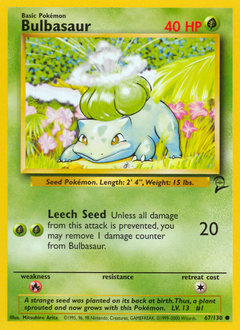
Base Set 2 Bulbasaur #67: Not the 1999 Original
Reviewed by Caleb Stapel · Collector · Updated September 2026
Bulbasaur is Unlimited on Base Set 2 (2000), card 67/130. Raw copies benchmark around $2.44, while a PSA 10 gem is recorded around $206.25.
This page covers the Unlimited version specifically. The identification steps below confirm which set and print you are holding.
| Grade | Market Price | What It Means |
|---|---|---|
| Ungraded (raw) | $2.44 | Condition and authenticity both unpriced in — the risk grade |
| PSA 7 (NM) | $15.12 | Solid collector grade |
| PSA 8 (NM-MT) | $25.08 | The liquidity anchor: high demand, realistic grade |
| PSA 9 (Mint) | $28.14 | Elite tier |
| PSA 10 (Gem Mint) | $206.25 | Gem Mint — ~202 recorded at PSA 10 |
Prices: PriceCharting sold-comp data, September 16, 2026 — refreshed monthly. Comps move; verify current sold prices before transacting.
Live Now on eBay: Unlimited Bulbasaur
What the card is actually being offered for right now. Every listing below is filtered to the genuine genuine Unlimited version — no repacks, mystery slabs, card skins, or multi-card lots. These are asking prices, not sold comps, so treat them as the top of the market rather than what copies are changing hands for.
Loading current listings…
Which One Do You Have? Identifying a Base Set 2 (2000) Card
Base Set 2 is a reprint set, not a new expansion: it collects cards from the original Base Set and from Jungle into one 130-card checklist. It has no 1st Edition printing and no Shadowless printing — it was a single unlimited run, which makes identification simple compared with the original Base Set.
- Set symbol: Base Set 2 cards carry a 2-ball set symbol in the lower-right of the art box. Base Set cards have no symbol.
- Copyright line: Base Set 2 reads ©1995-2000. The original Base Set unlimited reads ©1995, 96, 98.
- No stamp exists: a Base Set 2 card can never carry an Edition 1 stamp — if it does, the stamp was added.
Because the artwork is recycled from the 1999 sets, Base Set 2 cards are routinely mistaken for Base Set pulls. The set symbol is the only reliable tell.
Is It Even Real? The Short Answer
Older-set cards below the holo tier are very rarely counterfeited, so authentication is mostly about condition rather than forgery. The one thing worth checking is that the card is the printing it claims: 1st Edition stamps are the single most commonly added mark, and the set symbol is the tell that a card comes from the set you think it does.
The wider verification method is in How to Spot a Fake Pokémon Card.
Print History & Where This Card Came From
Base Set 2 (2000) Bulbasaur 67/130, on the Unlimited version. Base Set 2 is a reprint set, not a new expansion: it collects cards from the original Base Set and from Jungle into one 130-card checklist. It has no 1st Edition printing and no Shadowless printing — it was a single unlimited run, which makes identification simple compared with the original Base Set.
This set has no 1st Edition printing, so there is no stamped/unstamped split to price against. What separates copies here is condition and, where a reverse holo exists, the finish.
Pop Report Forensics
PriceCharting’s census records roughly 1,038 PSA-graded copies of this card, of which about 202 sit at PSA 10. It also carries a CGC count. PSA’s census is the deeper of the two — PSA graded far more of the vintage era than any other company, and the gap between graders is a market fact rather than a data problem.
Two census caveats are core to reading these numbers honestly. Graded counts are submission tallies, not unique cards — crack-and-regrade resubmissions inflate the total, so the number of distinct gem copies is lower. And the census is a floor, not a final figure: it grows with every submission wave.
Errors & Oddities: The Honest Answer
No repeating, community-verified error card is documented for this card in its set. It does not appear in the repeating-errors section of the Elite Fourum Master Misprint Guide.
Press hickeys, misfeeds, off-cuts and pack-crimp cards escaped quality control in every era, so one-off curiosities exist. They carry value when the misprint community verifies repeats; a single copy usually does not. Marketplace listings that call an ordinary card an “error” are far more often damage or a misattributed print variant.
The Grade Ladder for This Card
Where this card’s own grades sit, on PriceCharting sold-comp data (September 2026) — and, where a reverse holo of the identical card exists, how the two finishes compare:
| Grade | Market Price | What It Means | |
|---|---|---|---|
| Ungraded (raw) | $2.44 | — | The risk grade — condition unpriced in |
| PSA 7 | $15.12 | — | Collector grade |
| PSA 8 | $25.08 | — | The liquidity anchor — where most copies trade |
| PSA 9 | $28.14 | — | Elite tier |
| PSA 10 | $206.25 | — | Gem Mint — the top of the ladder |
Comps move weekly — verify current sold prices before any transaction, and remember raw vintage cards carry maximum counterfeit risk.
The Artist
Bulbasaur was illustrated by multiple artists across the vintage era, and this printing is one of them. Artist attribution is printed in the lower-left of the card art on every vintage card — read it off the card itself rather than trusting a listing.
Caleb's Collector Verdict
If your copy turns out to be a different printing than you assumed, that is worth knowing before you buy or sell — see should you grade Pokémon cards? for when the fee math actually works.
People Also Ask
How much is this Bulbasaur worth?
It depends entirely on grade: ungraded copies benchmark around $2.44, PSA 7 around $15.12, PSA 8 around $25.08, PSA 9 around $28.14 and PSA 10 around $206.25 (PriceCharting sold-comp data, September 2026). Comps move weekly — verify current sold prices before buying or selling.
How rare is the PSA 10 of this card?
PriceCharting's census records roughly 1,038 PSA-graded copies of this card, of which about 202 sit at PSA 10. Graded counts are submission tallies rather than unique cards, and the census updates monthly, so treat it as a floor rather than a final figure.
How do I tell which version of this card I have?
Use the identification steps on this page: the Edition 1 stamp, the drop shadow on the art box, the copyright year and the set symbol between them settle which printing and which set the card belongs to.
Does this card have any known error?
No repeating, community-verified error is documented for it in the Elite Fourum Master Misprint Guide. Listings calling an ordinary copy an “error” are usually damage or a misattributed print variant.