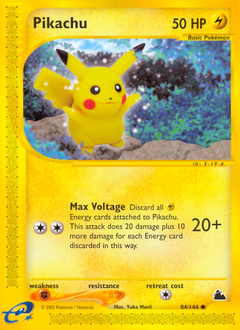
Skyridge Pikachu #84: A Common Worth $160
Reviewed by Caleb Stapel · Collector · Updated September 2026
A Common card asking $161.52 raw. That is the whole curiosity here. Skyridge is the scarcest Wizards set ever printed, and even its commons behave like mid-tier cards from anywhere else — there simply is not much of it. There is also a genuine oddity: this is the only e-Reader application ever built around Pikachu, and it took four cards to run. Raw copies trade around $161.52, and a PSA 10 gem has cleared $2,189.56.
This page covers the standard print of this card. Skyridge has no 1st Edition — any listing claiming one is mislabelled or fraudulent — so the distinction that matters here is between the normal card and the reverse holo.
| Grade | Market Price | Share of graded copies |
|---|---|---|
| Ungraded (raw) | $161.52 | — |
| PSA 7 (NM) | $144.00 | 6.7% |
| PSA 8 (NM-MT) | $180.50 | 17.4% |
| PSA 9 (Mint) | $435.00 | 40.3% |
| PSA 10 (Gem Mint) | $2,189.56 | 28.9% |
| Grade 6 or below | — | 6.7% |
Prices: PriceCharting sold-comp data, September 16, 2026 — refreshed monthly. Comps move; verify current sold prices before transacting.
Live Now on eBay: Normal Pikachu
What the card is actually being offered for right now. Every listing below is filtered to the genuine genuine Normal version — no repacks, mystery slabs, card skins, or multi-card lots. These are asking prices, not sold comps, so treat them as the top of the market rather than what copies are changing hands for.
Loading current listings…
Which One Do You Have? Identifying a Skyridge (2003) Card
Skyridge is the final e-Card set and the last set Wizards of the Coast printed before the licence moved. Short print runs at the end of the era make it one of the scarcer vintage sets.
- e-Reader strip: present along the bottom border, as with the rest of the e-Card era.
- Set symbol: a Skyridge symbol in the lower-right of the art box.
- No Edition 1 stamp exists.
Skyridge sits at the end of the WotC licence, so it was produced in smaller quantity than the 1999–2000 sets. That scarcity is why its cards price above comparable cards from earlier sets.
 Click to enlarge
 Click to enlarge
The normal print and the reverse holo are the same card and the same number — the only difference is the foil. Prices above are PSA 8 sold comps from PriceCharting, September 2026.
About This Card and Set
Skyridge is the last Pokémon set Wizards of the Coast ever printed, and it went out with a fight. It reached the US on 12 May 2003, made up of two Japanese sets spliced together, and by then the licence was already headed to Nintendo. Wizards sued Nintendo in October 2003 alleging breach of contract and patent infringement. Meanwhile a final Wizards-designed set, Jamboree, was announced and then blocked — never released. Former Wizards staff have alleged its contents were absorbed into a Nintendo-era set; that claim is an allegation from interviews rather than a proven fact, and we are labelling it as such.
What that history did to supply is the reason this page exists. Skyridge received one print run, was never reprinted, and Pokémon's popularity was in a trough in 2003 after the first boom had passed. Nobody was buying cases to keep sealed; one collector recalls a Toys R Us with three packs left in storage. On top of that, the e-Series sets are large — Skyridge has 182 cards — so per-card supply thins further still. The hobby's own shorthand is that you would need to open something like three times as many Skyridge boxes to pull any given holo as you would a Base Set equivalent.
And the set has been re-rated. It was widely disliked at the time — plenty of collectors remember the e-Reader card borders putting them off entirely — and it is now one of the most sought-after vintage sets, with a sealed box having sold for $212,500. That trajectory is worth knowing before you look at a $161 common and call it expensive.
How Rare Is This Card?
Skyridge's census is thin across the board, and this card is the friendliest distribution in this batch. PriceCharting records 655 PSA-graded copies, of which 189 are PSA 10 — a gem rate of 28.9%. Only 6.7% land at grade 6 or below. The reason the numbers look healthy is the same reason the card is scarce: this set was bought by collectors, in 2003, who put their pulls straight into sleeves. Very few were played.
| Card | PSA 10s | Total graded | Gem rate |
|---|---|---|---|
| Skyridge Pikachu #84 (2003) | 189 | 655 | 28.9% |
| 1st Edition Base Set Pikachu #58 (1999) | 549 | 4,065 | 13.5% |
Put those together and the vintage market stops looking like one thing. The 1999 Base Set Pikachu has seven times this card's graded population and gems at half the rate — yet the Skyridge card is worth more raw, because supply rather than condition is the binding constraint. Vintage is not one curve. It is a set-by-set story about how many were made and how hard they were kept.
Both standing caveats apply. Graded counts are submission tallies rather than unique cards, and the census is a floor, not a final number.
Known Error Cards
This card has no known error, and the set it sits in has remarkably few. Bulbapedia documents Skyridge misprints on Nidoqueen, Persian and Nidoran, none of which are this card. It is worth saying plainly, because Skyridge enjoys a reputation unusual for the era: as collectors put it, the set had some of the best quality control of any Wizards printing, which is why genuine Skyridge errors are rare enough to be worth photographing when they turn up.
What this card does have is a variant question and a naming trap. The variants are simply normal and reverse holo — the reverse holo is much scarcer, and there is no special or secret printing of Pikachu #84. And Skyridge has no 1st Edition. Wizards retired the stamp after Neo Destiny, so all three e-Series sets are single-print runs. Any "1st Edition Skyridge" listing is mislabelled at best.
One detail worth knowing if you care about the e-Reader era: Skyridge did not carry the "a" and "b" dot-code card variants that made Aquapolis notoriously confusing. Instead, the era's cards carry serial codes, and collecting every serial for every card is a documented community project rather than an established checklist.
The Artist
Yuka Morii is the reason this card looks the way it does, and her method is unlike anyone else's in the hobby. She does not draw Pokémon. She sculpts them in clay, photographs the figure in real light, and paints the photograph — which is why her cards read as objects with weight rather than illustrations. The Skyridge Pikachu is a heavily processed photograph of a clay Pikachu in the wild.
Her account of the approach is disarmingly plain: she moved from 2D illustration into clay work, and aims for something that is "outstanding but at the same time cute," built from round edges and a peaceful atmosphere. Her line about the job — "My job is to appreciate and make small things" — is quoted often, and it fits a set that put a modelled Pikachu into a real forest.
She is also a case of a taste changing over time. Plenty of collectors disliked the clay style when these cards were new and now consider it a highlight of the era, and CGC has published an artist showcase on her work. If the card looks unusual to you, that is a correct reading, not a printing fault.
🎨 Coming: the artist value rankings
Caleb's Collector Verdict
Who is this card for? The set completer first — Skyridge is a 182-card set that people finish once, and this is a required slot. Then the collector who wants a genuinely scarce Wizards card without paying holo money, and the Morii admirer, who is buying a small sculpture rather than an illustration.
What it is not is a Pikachu card with a Pikachu story. There is no famous copy, no misprint, no nickname here — the reason this card is interesting is entirely the set it came from and the way it was made. If you are buying it because you like Pikachu, you are buying Skyridge by proxy. That is fine, as long as it is deliberate.
Honest strengths: from the scarcest Wizards set, a Morii clay original, a Common that behaves like a mid-tier card, and an unusually healthy 28.9% gem rate for anything this old. Honest trade-offs: priced on set scarcity rather than any card-specific fame, a set whose demand has already re-rated upward (so you are buying after the move, not before it), and $160 for a card most people would file as bulk if they did not know the set.
People Also Ask
Is my Skyridge Pikachu real or fake?
The e-Card era is unusually hard to counterfeit, and the dot codes on the card are the reason — they are difficult to reproduce convincingly, which is a real advantage for this card. The most common problem is not a fake but a mislabel: Skyridge has no 1st Edition, so any listing claiming one is wrong. Full checks in How to Spot a Fake Pokémon Card.
Should I grade this card?
The odds are the best here of any card in this batch, and the grade floor is the reason. Raw is around $161.52 and PSA 7 around $144.00 — below the raw card, which is normal for low-value cards, so grading only pays from PSA 9 ($435.00) or PSA 10 ($2,189.56) against the $59.99 fee. With 28.9% of copies reaching a 10 and 40.3% landing at PSA 9, the odds are genuinely favourable — and only 6.7% fall to grade 6 or below. It ranks #36 of 101 in Cards Worth Chasing. Check your copy with the grading guide first.
Why is a Common card worth $160?
Because of how little Skyridge was printed. Wizards lost the licence, the set had one print run, it was never reprinted, and Pokémon's popularity was in a trough in 2003 — so almost nobody opened it to keep. With 182 cards in the set, per-card supply is thin enough that even a Common behaves like a mid-tier card from another set.
Is there a 1st Edition Skyridge Pikachu?
No. Wizards retired the 1st Edition stamp after Neo Destiny, so all three e-Series sets — Expedition, Aquapolis and Skyridge — are single print runs with no stamped version. Any listing advertising a 1st Edition Skyridge card is mislabelled or fraudulent.
What is the e-Reader feature on this card?
The standard (non-holo) card carries an e-Reader dot-code strip, and scanning it plays Pika Pop — which is the only e-Reader application ever built around Pikachu, despite Pikachu being the franchise mascot. It requires four cards to run. Note that the reverse holo version cannot be scanned; only the standard print works.