
Pidgeotto 1st Edition Base Set: Seventy-Eight Episodes
Reviewed by Caleb Stapel · Collector · Updated September 2026
Pidgeotto was the second Pokémon Ash caught in Kanto, and it stayed on his team for seventy-eight episodes before evolving so it could guard a wild flock — one of the longest tenures of the anime’s first era. It is also the second stage of the three-stage bird line that every later generation repeated.
This page covers the 1st Edition printing specifically — the stamped, shadowless-stock version from the original January 1999 run. If you are unsure which of the Base Set Pidgeotto printings you own, the 3-second test below settles it before you read any further.
| Grade | Market Price | Share of graded copies |
|---|---|---|
| Ungraded (raw) | $78 | — |
| PSA 7 (NM) | $126 | 10.9% |
| PSA 8 (NM-MT) | $145 | 20.5% |
| PSA 9 (Mint) | $260 | 38.6% |
| PSA 10 (Gem Mint) | $1,575 | 14.6% |
| Grade 6 or below | — | 15.4% |
Prices and population shares: the Cards Worth Chasing ranking, PSA only, September 2026. Shares are of all PSA-graded copies of this card, so they sum to 100% with the grade-6-and-below row. Grading cost basis $59.99 (PSA Standard). Comps move — verify current sold prices before transacting.
Live Now on eBay: 1st Edition Pidgeotto
What the card is actually being offered for right now. Every listing below is filtered to the genuine 1st Edition card — no repacks, mystery slabs, card skins, or multi-card lots. These are asking prices, not sold comps, so treat them as the top of the market rather than what copies are changing hands for. Buying through these links supports the site at no extra cost to you.
Loading current listings…
Which One Do You Have? The 3-Second Test
Most people who say “I have a 1st Edition Pidgeotto” don’t. Retail packs in 1999–2000 were overwhelmingly Unlimited printing — and that’s fine, it’s the same iconic card. The fast check, in order:
- Right edge of the art box: a dark drop shadow = Unlimited or 4th Print. No shadow = keep going.
- Left of the art box: a black “Edition 1” stamp = 1st Edition. No stamp + no shadow = Shadowless.
- Bottom copyright line: ©1999-2000 = 4th Print. The font weight is the tiebreaker — thin HP text means an early print.
Pidgeotto is a Stage 1 Colorless with 60 HP, evolving from Pidgey, illustrated by Ken Sugimori. Centring is the usual weak point on this card; the surface is generally sound.
The four printings of Base Set each have their own price and history: 1st Edition · Shadowless · Unlimited · 4th Print.
Click to enlarge
 Click to enlarge
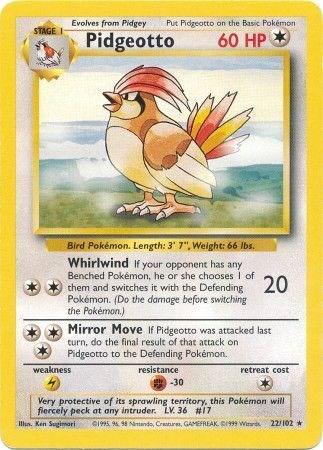 Click to enlarge
 Click to enlarge
PSA 8 prices from PriceCharting sold-comp data, September 2026. Unlimited and 4th Print look nearly identical — the copyright year is the difference. Each printing is its own card with its own price and history; see every printing: 1st Edition · Shadowless · Unlimited · 4th Print.
About This Card and Set
Pidgeotto is card 22/102, a first-printing English Base Set card: the 1st Edition run, carrying the black “Edition 1” stamp below and to the left of the artwork, on shadowless stock with no drop shadow along the art box. Within the set it is one of the sixteen non-holo Rares, the band that sits between the sixteen holofoil cards and the Uncommons.
Its first release was not English. Pidgeotto debuted in Japan’s Expansion Pack in October 1996 as a non-holo Rare there, before Wizards of the Coast brought it into the English Base Set in January 1999. Two English reprints followed: Base Set 2 at 28/130 and Legendary Collection at 34/110. A prototype Trainer Deck B print, never sold at retail, carries a red border and the deck name on the reverse. The 1st Edition stamp belongs only to the Base Set print.
Much of the card’s pull is narrative. Pidgeotto was the second Pokémon Ash caught in Kanto in the animated series, and it stayed on his team for seventy-eight episodes before evolving to guard a wild flock. The Pidgey line also became an unlikely internet icon in 2014 when a long-running community playthrough of the Game Boy games dubbed its Pidgeot “Bird Jesus” — a nickname for that playthrough’s Pidgeot, not for this card. The species opens the franchise’s sequence of three-stage bird lines, named for the pigeon but drawn closer to a bird of prey.
Ken Sugimori’s credit here is one of the early watercolour illustrations reused across Pokémon merchandise of the period, set against a photographic stock background rather than drawn as bespoke card art.
How Rare Is This Card?
Read this card by its grade split rather than by a headline population. 14.6% of PSA-graded copies reach PSA 10, 15.4% come back grade 6 or below, and the rest land in between — which is what set the price ladder above.
Pidgeotto reaches value at a PSA 8 rather than only at the top grade — an unusually forgiving spread for a 1999 card, and the reason clean raw copies are worth submitting.
| Card | PSA 10s | Total graded | Gem rate |
|---|---|---|---|
| 1st Edition Pidgeotto (1999) | ~208 | ~1,427 | 14.6% |
| Charizard ex #199, S&V 151 (2023) | 29,679 | 102,490 | ~29% |
PriceCharting population data, September 2026. The modern row is a combined PSA + CGC count; the 1999 row is PSA, the way it is normally quoted.
For scale, a comparable modern chase card converts to a gem grade at roughly 29%. Modern cards grade far better than vintage ones — not because they are better cards, but because a 1999 card was printed before grading was mainstream and then spent two decades in a binder.
Source: the PSA-only figures behind the Cards Worth Chasing ranking, September 2026. Two caveats stay attached to every population figure on this site. Graded counts are submission tallies, not unique cards — resubmissions inflate the total. And the census is a floor, not a final number.
Known Error Cards
No design error or repeating ink error is documented for Pidgeotto 22/102 in the 1st Edition printing. Bulbapedia’s Base Set error list, PSA’s Pokémon Error Guide, the PokéBeach error database and Elite Fourum’s English Base Set Master Misprint Guide all catalogue Base Set errors by card name and print run, and none carries a Pidgeotto entry. The documented Base Set errors belong to other cards: the missing Stage text on Unlimited Blastoise, the missing damage figure on Shadowless Ninetales, the “D.efending” typo on Unlimited Beedrill, and the evolution-box error on Unlimited Wartortle.
Two weaker claims should not be mistaken for catalogue entries. A “missing rare symbol” Pidgeotto appears only once, as an unconfirmed line in a single forum list, and is not corroborated elsewhere. Separately, one old list notes that the attack energy symbols sit slightly off-centre on roughly forty Base Set Pokémon including Pidgeotto, across both the 1st Edition and Shadowless issues — a set-wide typesetting trait rather than a card-specific error, and one absent from all four references.
What Makes This Card Collectible?
Pidgeotto is collected for nostalgia that is unusually well documented, on a card that also anchors the set’s bird line:
- Seventy-eight episodes. One of the longest tenures of any Pokémon on Ash’s team in the anime’s first era, and the reason the card reads as nostalgia rather than filler.
- The first of the three-stage bird lines. The Pidgey family opens a design pattern every later generation repeated.
- Two English reprints and a prototype. Base Set 2, Legendary Collection, and a never-retailed Trainer Deck B print all carry the same Sugimori art.
Pidgey sits at 57 in the same set; the Base Set hub covers the run.
The Artist: Ken Sugimori
Ken Sugimori is one of the illustrators who defined the look of the original English Pokémon TCG, and Pidgeotto is one of their Base Set contributions. This section will carry their full numbers when the artist guide lands.
Caleb's Collector Verdict
Pidgeotto is the nostalgia pick of this block, and it has the documentation to back the feeling: a seventy-eight-episode anime tenure, the opening of the franchise’s bird-line pattern, and artwork reused across three English printings.
People Also Ask
Is my 1st Edition Pidgeotto real or fake?
The 1999 Base Set cards are the most counterfeited in the hobby, and for a raw copy worth real money you cannot settle it from a photo. The checks that catch most fakes: the light test, the stamp rule (read together with the drop shadow and the 1995-99 copyright line, never alone), and the back. Above a few hundred dollars, a raw copy should get professional pre-authentication. The full fake-detection walkthrough covers all of it.
Should I grade this card?
Because the card pays from PSA 8 up rather than only at PSA 10, the mid grades are usable — a clean copy is worth submitting. See Should You Grade Pokémon Cards? for the fee maths, and check a raw copy with the CardGrader scanner before sending it in.