
Double Colorless Energy 1st Edition Base Set: Design Object
Reviewed by Caleb Stapel · Collector · Updated September 2026
Double Colorless Energy is the first Special Energy card printed for the Pokémon TCG — the point at which an entire card category entered the game. It is also the only card in Base Set’s seven-card energy block that is not a basic Energy.
This page covers the 1st Edition printing specifically — the stamped, shadowless-stock version from the original January 1999 run. If you are unsure which of the Base Set Double Colorless Energy printings you own, the 3-second test below settles it before you read any further.
| Grade | Market Price | Share of graded copies |
|---|---|---|
| Ungraded (raw) | $27 | — |
| PSA 7 (NM) | $45 | 9.6% |
| PSA 8 (NM-MT) | $56 | 24.3% |
| PSA 9 (Mint) | $214 | 41.2% |
| PSA 10 (Gem Mint) | $1,584 | 13.8% |
| Grade 6 or below | — | 11.1% |
Prices and population shares: the Cards Worth Chasing ranking, PSA only, September 2026. Shares are of all PSA-graded copies of this card, so they sum to 100% with the grade-6-and-below row. Grading cost basis $59.99 (PSA Standard). Comps move — verify current sold prices before transacting.
Live Now on eBay: 1st Edition Double Colorless Energy
What the card is actually being offered for right now. Every listing below is filtered to the genuine 1st Edition card — no repacks, mystery slabs, card skins, or multi-card lots. These are asking prices, not sold comps, so treat them as the top of the market rather than what copies are changing hands for. Buying through these links supports the site at no extra cost to you.
Loading current listings…
Which One Do You Have? The 3-Second Test
Most people who say “I have a 1st Edition Double Colorless Energy” don’t. Retail packs in 1999–2000 were overwhelmingly Unlimited printing — and that’s fine, it’s the same iconic card. The fast check, in order:
- Right edge of the art box: a dark drop shadow = Unlimited or 4th Print. No shadow = keep going.
- Left of the art box: a black “Edition 1” stamp = 1st Edition. No stamp + no shadow = Shadowless.
- Bottom copyright line: ©1999-2000 = 4th Print. The font weight is the tiebreaker — thin HP text means an early print.
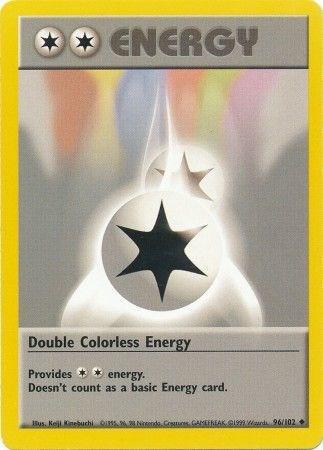
Double Colorless Energy is a Energy card illustrated by Keiji Kinebuchi. Basic and special Energy from this run were handled constantly; check the edges for shuffle wear before the surface.
The four printings of Base Set each have their own price and history: 1st Edition · Shadowless · Unlimited · 4th Print.
Click to enlarge
 Click to enlarge
 Click to enlarge
 Click to enlarge
PSA 8 prices from PriceCharting sold-comp data, September 2026. Unlimited and 4th Print look nearly identical — the copyright year is the difference. Each printing is its own card with its own price and history; see every printing: 1st Edition · Shadowless · Unlimited · 4th Print.
About This Card and Set
Double Colorless Energy is card 96/102 of the English Base Set — an Uncommon, non-holo Energy card, and the only card in the set’s seven-card energy block that is not a basic Energy. Fighting, Fire, Grass, Lightning, Psychic and Water appear there as Basic Energy; card 96 does not. It was the first Special Energy card printed for the Pokémon TCG — the point at which an entire card category entered the game.
The distinction is structural, not decorative. Basic Energy is one of six elemental types and is handled as such. A Special Energy is a named card, subject to the four-copy limit, and set apart from anything a rule calls “basic Energy.” Base Set needed exactly one card to demonstrate that second category, and this is the card that carries it.
In scope here is the 1st Edition: the first English print run, on the shadowless template, carrying the black “Edition 1” stamp to the left of the artwork, before the drop shadow appeared behind the illustration window. The same sheets were also cut and issued unstamped as the Shadowless run — the stamp is the whole difference between the two.
The design credits split in a way collectors rarely notice. Keiji Kinebuchi is credited as illustrator and designed the Energy cards’ layouts; Mitsuhiro Arita designed the energy symbols themselves. The card was reprinted widely, with new art and revised wording, and its Japanese name changed at HeartGold & SoulSilver — under the game’s reprint convention, these are one card in successive editions rather than separate cards.
How Rare Is This Card?
Read this card by its grade split rather than by a headline population. 13.8% of PSA-graded copies reach PSA 10, 11.1% come back grade 6 or below, and the rest land in between — which is what set the price ladder above.
A strong 13.8% Gem Mint rate on a $27 raw — one of the cheapest cards of this group, on the card that created its own card category.
| Card | PSA 10s | Total graded | Gem rate |
|---|---|---|---|
| 1st Edition Double Colorless Energy (1999) | ~228 | ~1,652 | 13.8% |
| Charizard ex #199, S&V 151 (2023) | 29,679 | 102,490 | ~29% |
PriceCharting population data, September 2026. The modern row is a combined PSA + CGC count; the 1999 row is PSA, the way it is normally quoted.
For scale, a comparable modern chase card converts to a gem grade at roughly 29%. Modern cards grade far better than vintage ones — not because they are better cards, but because a 1999 card was printed before grading was mainstream and then spent two decades in a binder.
Source: the PSA-only figures behind the Cards Worth Chasing ranking, September 2026. Two caveats stay attached to every population figure on this site. Graded counts are submission tallies, not unique cards — resubmissions inflate the total. And the census is a floor, not a final number.
Known Error Cards
No error is documented for the 1st Edition printing of Double Colorless Energy. The four standard references — Bulbapedia’s error-card list, PSA’s Pokémon Error Guide, the PokeBeach error database and Elite Fourum’s WOTC corrected-error and Base Set misprint guides — enumerate Base Set errors card by card, and none of them lists 96/102. Nothing in the card’s text or layout varies across the 1st Edition copies these sources document.
Base Set does carry a documented Energy-card error, and it touches Water Energy at 102/102, not this card. The Water Energy misalignment is a mass-produced design error in which the top banner was set too high: the symbol and the word ENERGY ride above their intended position, and the banner loses its edge design along the top, left and right. Collectors place it in the Unlimited run, not the 1st Edition. A 1st Edition copy labelled “Error” by a seller is not backed by any of the four catalogue sources.
What Makes This Card Collectible?
Double Colorless Energy is collected as a design object — the card that created its own category:
- The first Special Energy card. An entire card category entered the game with this one, and Base Set printed exactly one of them.
- One of seven, and unlike the other six. Basic Energy fills the rest of the energy block; card 96 is the only one that is named rather than elemental.
- A split design credit. Kinebuchi designed the Energy layouts; Arita designed the energy symbols themselves — two different jobs behind one card.
The 1st Edition printing hub covers the stamp and shadow, and the Base Set hub places the Energy half of the set in context.
The Artist: Keiji Kinebuchi
Keiji Kinebuchi is one of the illustrators who defined the look of the original English Pokémon TCG, and Double Colorless Energy is one of their Base Set contributions. This section will carry their full numbers when the artist guide lands.
Caleb's Collector Verdict
Double Colorless Energy is the only Energy card in Base Set that is not a basic Energy, and the first Special Energy the game ever printed. As a design object it is the most structurally significant card in the set.
People Also Ask
Is my 1st Edition Double Colorless Energy real or fake?
The 1999 Base Set cards are the most counterfeited in the hobby, and for a raw copy worth real money you cannot settle it from a photo. The checks that catch most fakes: the light test, the stamp rule (read together with the drop shadow and the 1995-99 copyright line, never alone), and the back. Above a few hundred dollars, a raw copy should get professional pre-authentication. The full fake-detection walkthrough covers all of it.
Should I grade this card?
A 13.8% gem rate on a $27 raw is one of the better ratios in this run, so a clean copy is a fair submission by the numbers. See Should You Grade Pokémon Cards? for the fee maths, and check a raw copy with the CardGrader scanner before sending it in.