
Farfetch'd 1st Edition Base Set: The Evolution That Waited
Reviewed by Caleb Stapel · Collector · Updated September 2026
For two decades Farfetch’d had no evolution at all, which is precisely what changed in 2019 when a Galarian form arrived with its own evolved stage. The Base Set card was left untouched, but collectors started reading it differently: this is where the original form first appeared. The English name, meanwhile, is a pun the Japanese original does not share.
This page covers the 1st Edition printing specifically — the stamped, shadowless-stock version from the original January 1999 run. If you are unsure which of the Base Set Farfetch'd printings you own, the 3-second test below settles it before you read any further.
| Grade | Market Price | Share of graded copies |
|---|---|---|
| Ungraded (raw) | $35 | — |
| PSA 7 (NM) | $51 | 9.6% |
| PSA 8 (NM-MT) | $86 | 19.4% |
| PSA 9 (Mint) | $223 | 41.1% |
| PSA 10 (Gem Mint) | $1,138 | 18.8% |
| Grade 6 or below | — | 11.1% |
Prices and population shares: the Cards Worth Chasing ranking, PSA only, September 2026. Shares are of all PSA-graded copies of this card, so they sum to 100% with the grade-6-and-below row. Grading cost basis $59.99 (PSA Standard). Comps move — verify current sold prices before transacting.
Live Now on eBay: 1st Edition Farfetch'd
What the card is actually being offered for right now. Every listing below is filtered to the genuine 1st Edition card — no repacks, mystery slabs, card skins, or multi-card lots. These are asking prices, not sold comps, so treat them as the top of the market rather than what copies are changing hands for. Buying through these links supports the site at no extra cost to you.
Loading current listings…
Which One Do You Have? The 3-Second Test
Most people who say “I have a 1st Edition Farfetch'd” don’t. Retail packs in 1999–2000 were overwhelmingly Unlimited printing — and that’s fine, it’s the same iconic card. The fast check, in order:
- Right edge of the art box: a dark drop shadow = Unlimited or 4th Print. No shadow = keep going.
- Left of the art box: a black “Edition 1” stamp = 1st Edition. No stamp + no shadow = Shadowless.
- Bottom copyright line: ©1999-2000 = 4th Print. The font weight is the tiebreaker — thin HP text means an early print.
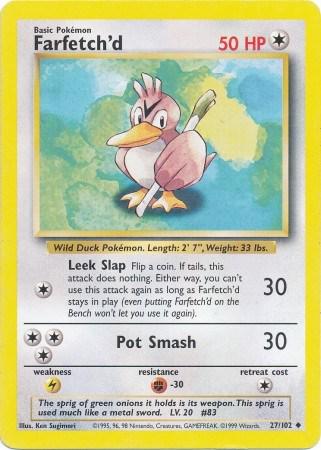
Farfetch'd is a Basic Colorless with 50 HP, illustrated by Ken Sugimori. A 50 HP Basic was often played; check the corners for wear before the surface.
The four printings of Base Set each have their own price and history: 1st Edition · Shadowless · Unlimited · 4th Print.
Click to enlarge
 Click to enlarge
 Click to enlarge
 Click to enlarge
PSA 8 prices from PriceCharting sold-comp data, September 2026. Unlimited and 4th Print look nearly identical — the copyright year is the difference. Each printing is its own card with its own price and history; see every printing: 1st Edition · Shadowless · Unlimited · 4th Print.
About This Card and Set
Farfetch’d appears in the 1999 English Base Set as card 27/102, an Uncommon non-holo Basic. The printing in scope is the 1st Edition: the launch run, struck on the shadowless template, carrying the black “Edition 1” stamp below the artwork. Shadowless stock means no drop shadow at the art window and the thinner first-print type, and the stamp marks the opening weeks of production.
Its name is the card’s most distinctive feature, and it is a localisation rather than a translation. The Japanese species name compresses a proverb — literally “a duck comes bearing green onions” — meaning both a convenient windfall and a mark walking trustingly toward trouble. English localisation dropped the proverb for a different pun: far-fetched, barely believable. Neither name translates the other.
The games made a running joke of the species’ scarcity. Red and Blue offer exactly one Farfetch’d, obtained by trading a Spearow to a girl in Vermilion City; it arrives with a nickname already attached, and no Name Rater will rename a traded Pokémon. The anime called it a delicacy cooked with its own leek, and gave that as the reason for its decline. The card reached English-speaking collectors on 9 January 1999, with Ken Sugimori’s artwork carried over from the Japanese Expansion Pack of October 1996.
For two decades the species had no evolution, and card 27 read as a closed chapter. That changed in 2019 with a Galarian Farfetch’d and its own evolved form. The new line left the Base Set card untouched, but it changed how collectors read it: the original form’s first appearance rather than the whole of its story.
How Rare Is This Card?
Read this card by its grade split rather than by a headline population. 18.8% of PSA-graded copies reach PSA 10, 11.1% come back grade 6 or below, and the rest land in between — which is what set the price ladder above.
Farfetch’d converts to PSA 10 at one of the highest rates of this block, on a raw cost near the bottom of the set — the cheapest high-grade entry of the ten.
| Card | PSA 10s | Total graded | Gem rate |
|---|---|---|---|
| 1st Edition Farfetch'd (1999) | ~287 | ~1,525 | 18.8% |
| Charizard ex #199, S&V 151 (2023) | 29,679 | 102,490 | ~29% |
PriceCharting population data, September 2026. The modern row is a combined PSA + CGC count; the 1999 row is PSA, the way it is normally quoted.
For scale, a comparable modern chase card converts to a gem grade at roughly 29%. Modern cards grade far better than vintage ones — not because they are better cards, but because a 1999 card was printed before grading was mainstream and then spent two decades in a binder.
Source: the PSA-only figures behind the Cards Worth Chasing ranking, September 2026. Two caveats stay attached to every population figure on this site. Graded counts are submission tallies, not unique cards — resubmissions inflate the total. And the census is a floor, not a final number.
Known Error Cards
No error is catalogued for Farfetch’d 27/102 in any printing. The four standard references — Bulbapedia’s “Error cards”, the PSA Pokémon Error Guide, the PokeBeach error and misprint database, and Elite Fourum’s Masters Guide together with its English Base Set Master Misprint Guide — all inventory the same Base Set offenders: Blastoise, Ninetales, Vulpix, Wartortle, Diglett, Pikachu and Beedrill. Farfetch’d is absent from every one of them.
Two lookalikes are worth knowing about because they are not errors. Cards circulating as an “Earfetch’d” misprint, or as a Farfetch’d printed with the wrong Pokémon, were identified by collectors as bootlegs on font, colouring and a scanned-art overlay — counterfeits rather than press faults. What does apply to a 1st Edition Farfetch’d is the printing-wide stamp behaviour affecting 1st Edition commons and uncommons as a class: stamps transferred or inverted on the card back, grey or low-ink stamps, and smeared stamps on the front. Those are documented for the run, not for this card, and a single ink speck is a print defect rather than a catalogued error.
What Makes This Card Collectible?
Farfetch’d is collected because its story is still being written, and the Base Set card is where it starts:
- Two decades with no evolution. Card 27 read as a closed chapter until 2019, when a Galarian form arrived with its own evolved stage.
- A name that is a localisation, not a translation. A Japanese proverb about a duck bearing onions became an English pun with no equivalent.
- A running joke in the games. Exactly one obtainable, by trade, and it arrives already nicknamed so it can never be renamed.
The 1st Edition printing hub covers the stamp, and the Base Set hub places it in the run.
The Artist: Ken Sugimori
Ken Sugimori is one of the illustrators who defined the look of the original English Pokémon TCG, and Farfetch'd is one of their Base Set contributions. This section will carry their full numbers when the artist guide lands.
Caleb's Collector Verdict
Farfetch’d is the card whose meaning changed while the card did not: two decades of a closed line, then an evolution in 2019 that sent collectors back to the original. It also carries one of the set’s better localisation stories.
People Also Ask
Is my 1st Edition Farfetch'd real or fake?
The 1999 Base Set cards are the most counterfeited in the hobby, and for a raw copy worth real money you cannot settle it from a photo. The checks that catch most fakes: the light test, the stamp rule (read together with the drop shadow and the 1995-99 copyright line, never alone), and the back. Above a few hundred dollars, a raw copy should get professional pre-authentication. The full fake-detection walkthrough covers all of it.
Should I grade this card?
The odds are excellent here — 18.8% on a $35 raw — which makes it one of the better-value submissions in the batch. See Should You Grade Pokémon Cards? for the fee maths, and check a raw copy with the CardGrader scanner before sending it in.