
Dugtrio 1st Edition Base Set: The Seventeen-Year Art
Reviewed by Caleb Stapel · Collector · Updated September 2026
1st Edition · Base Set 1999 · Dugtrio #19/102
Dugtrio is Keiji Kinebuchi’s computer-rendered trio, and its artwork had an unusually long life: reused from the 1999 Base Set straight through to a 2016 reprint, seventeen years on the same illustration. The Diglett line behind it also has a documented origin — the designer’s own account is that it began as a childhood sketch.
This page covers the 1st Edition printing specifically — the stamped, shadowless-stock version from the original January 1999 run. If you are unsure which of the Base Set Dugtrio printings you own, the 3-second test below settles it before you read any further.
| Grade | Market Price | Share of graded copies |
|---|---|---|
| Ungraded (raw) | $107 | — |
| PSA 7 (NM) | $130 | 11.8% |
| PSA 8 (NM-MT) | $151 | 22.5% |
| PSA 9 (Mint) | $311 | 37.5% |
| PSA 10 (Gem Mint) | $1,950 | 12.1% |
| Grade 6 or below | — | 16.1% |
Prices and population shares: the Cards Worth Chasing ranking, PSA only, September 2026. Shares are of all PSA-graded copies of this card, so they sum to 100% with the grade-6-and-below row. Grading cost basis $59.99 (PSA Standard). Comps move — verify current sold prices before transacting.
Live Now on eBay: 1st Edition Dugtrio
What the card is actually being offered for right now. Every listing below is filtered to the genuine 1st Edition card — no repacks, mystery slabs, card skins, or multi-card lots. These are asking prices, not sold comps, so treat them as the top of the market rather than what copies are changing hands for. Buying through these links supports the site at no extra cost to you.
Loading current listings…
Which One Do You Have? The 3-Second Test
Most people who say “I have a 1st Edition Dugtrio” don’t. Retail packs in 1999–2000 were overwhelmingly Unlimited printing — and that’s fine, it’s the same iconic card. The fast check, in order:
- Right edge of the art box: a dark drop shadow = Unlimited or 4th Print. No shadow = keep going.
- Left of the art box: a black “Edition 1” stamp = 1st Edition. No stamp + no shadow = Shadowless.
- Bottom copyright line: ©1999-2000 = 4th Print. The font weight is the tiebreaker — thin HP text means an early print.
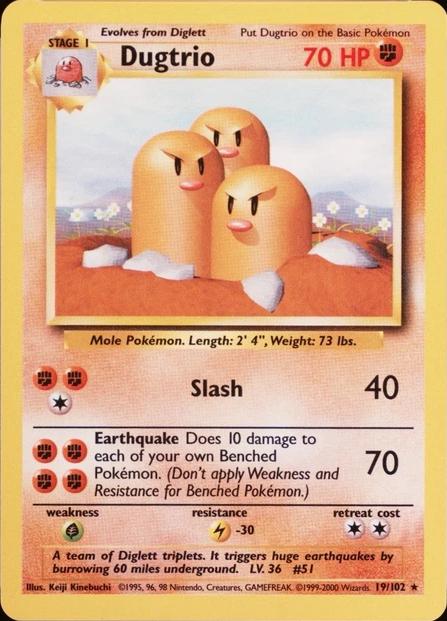
Dugtrio is a Stage 1 Fighting with 70 HP, evolving from Diglett, illustrated by Keiji Kinebuchi. Watch the surface on Fighting-type uncommons from this run; centering is usually acceptable.
Click to enlarge
 Click to enlarge
 Click to enlarge
 Click to enlarge
PSA 8 prices from PriceCharting sold-comp data, September 2026. Unlimited and 4th Print look nearly identical — the copyright year is the difference. Each printing is its own card with its own price and history; see every printing: 1st Edition · Shadowless · Unlimited · 4th Print.
About This Card and Set
Dugtrio is card 19/102 in the English Base Set, one of the sixteen non-holo Rares and the evolution of Diglett, which appears in the same set at 47. The 1st Edition is the stamped, shadowless-stock first run — identified by the circular “Edition 1” mark at the lower left of the artwork, no drop shadow at the right edge of the art, lighter type than later runs, and a copyright line reading 1995, 96, 98, 99.
Dugtrio is canonically three Diglett, and the line has a documented design origin: Game Freak’s Shigeki Morimoto has said he first drew Diglett as a childhood sketch. The card’s illustration is credited to Keiji Kinebuchi, and the same artwork was carried forward when 19/102 was reprinted in Base Set 2 in 2000 and again in the 2016 XY Evolutions set — a working life of some seventeen years on a single illustration.
That reuse is the point for a collector. The image was mass-printed in later runs, so the premium on a 1st Edition Dugtrio rests entirely on the stamp and the shadowless stock rather than on any scarcity of the artwork. Base Set is the only Wizards set that ran all three variants — stamped, unstamped shadowless, then shadowed Unlimited — so the stamp alone settles which printing a copy is.
In Japanese the line is Digda and Dugtrio, and the three-heads design has drawn the franchise’s more sceptical commentary over the years: the Pokédex line states plainly that the three are Diglett triplets, which is the whole of the matter.
How Rare Is This Card?
Start with the two numbers that describe the whole card: roughly 1,351 graded copies exist in PSA, and about 163 of those are PSA 10s. That is a gem rate near 12.1% — and the gem rate, not the raw population, is the number a collector should actually read. High-grade supply is what the market pays for.
| Card | PSA 10s | Total graded | Gem rate |
|---|---|---|---|
| 1st Edition Dugtrio (1999) | ~163 | ~1,351 | 12.1% |
| Charizard ex #199, S&V 151 (2023) | 29,679 | 102,490 | ~29% |
PriceCharting population data, September 2026. The modern row is a combined PSA + CGC count; the 1999 row is PSA, the way it is normally quoted.
For scale, compare it with the modern equivalent: a comparable modern chase card carries a gem rate near 29%. Modern cards grade far better than vintage ones — not because they are better cards, but because a 1999 card was printed before grading was mainstream and then spent two decades in a binder. A vintage gem count is not comparable to a modern one.
Dugtrio’s graded population is thin for a card this inexpensive — a non-holo Fighting Stage 1 was not a priority submission in 1999, and the artwork’s later reuse has not changed that.
Population source: PriceCharting, September 2026, PSA column only. Two caveats stay attached to every population figure on this site. Graded counts are submission tallies, not unique cards — resubmissions inflate the total, so the number of genuinely distinct gem copies is lower. And the census is a floor, not a final number: it grows with every submission wave.
Known Error Cards
No error is catalogued for the Base Set Dugtrio in any of the four standard references. Bulbapedia’s error list, the PSA Pokémon Error Guide, the PokéBeach misprint database, and the Elite Fourum WOTC and Base Set misprint guides all pass over 19/102 — including the 1st Edition printing. The first-issue run is not associated with a documented error of its own.
Two rumours attach to the name and need care. The “oversized attack-energy symbols” fault that circulates as a Dugtrio error belongs to the Dugtrio from Expedition Base Set (2002), a different card in a different set; it is not a Base Set flaw. Separately, older fan lists record a 1st Edition stamp printed in place of the weakness symbol. Those same lists mark the claim unconfirmed, and it appears in none of the four references — a one-off curiosity rather than a catalogued error.
What Makes This Card Collectible?
Dugtrio is collected for an unusually specific reason: it is one of the longest-serving illustrations in the game.
- One artwork, seventeen years. The same Kinebuchi illustration carried from the 1999 Base Set into a 2016 reprint.
- A documented design origin. The Diglett line began, by the designer’s own account, as a childhood sketch.
- The only set with all three variants. Stamped, shadowless and shadowed all ran within Base Set, so the stamp decides the printing.
The Magneton review covers the other Kinebuchi holo, and the Base Set hub places the Diglett line in the run.
The Artist: Keiji Kinebuchi
Keiji Kinebuchi is one of the illustrators who defined the look of the original English Pokémon TCG, and Dugtrio is one of their Base Set contributions. This section will carry their full numbers when the artist guide lands — how many cards they illustrated across the Wizards era and what one raw copy of each would cost.
Caleb's Collector Verdict
Dugtrio is the quiet pick in this block for anyone who collects the set’s illustration history rather than its mascots: a Kinebuchi render that stayed in print for seventeen years, on a card whose whole premium is the stamp.
People Also Ask
Is my 1st Edition Dugtrio real or fake?
The 1999 Base Set cards are the most counterfeited in the hobby, and for a raw copy worth real money you cannot settle it from a photo. The checks that catch most fakes: the light test (a genuine card is essentially opaque — a faint dark core line between the layers; cheap fakes glow through), the stamp rule (a real 1st Edition stamp is crisp and sits under the ink, and counterfeiters add stamps to Unlimited cards — read it with the drop shadow and the 1995-99 copyright line, never alone), and the back (fakes perfect the front and neglect the Poké Ball, the blue tone and the repeated text). Above a few hundred dollars, a raw copy should get professional pre-authentication. The full fake-detection walkthrough covers all of it.
Should I grade this card?
The population is small enough that a high grade stands out, and the raw cost is low enough that the fee is the main consideration. Worth it on a clean copy. See Should You Grade Pokémon Cards? for the fee maths, and check a raw copy with the CardGrader scanner before sending it in.