
Dragonair 1st Edition Base Set: The Rainbow Smear Rare
Reviewed by Caleb Stapel · Collector · Updated September 2026
1st Edition · Base Set 1999 · Dragonair #18/102
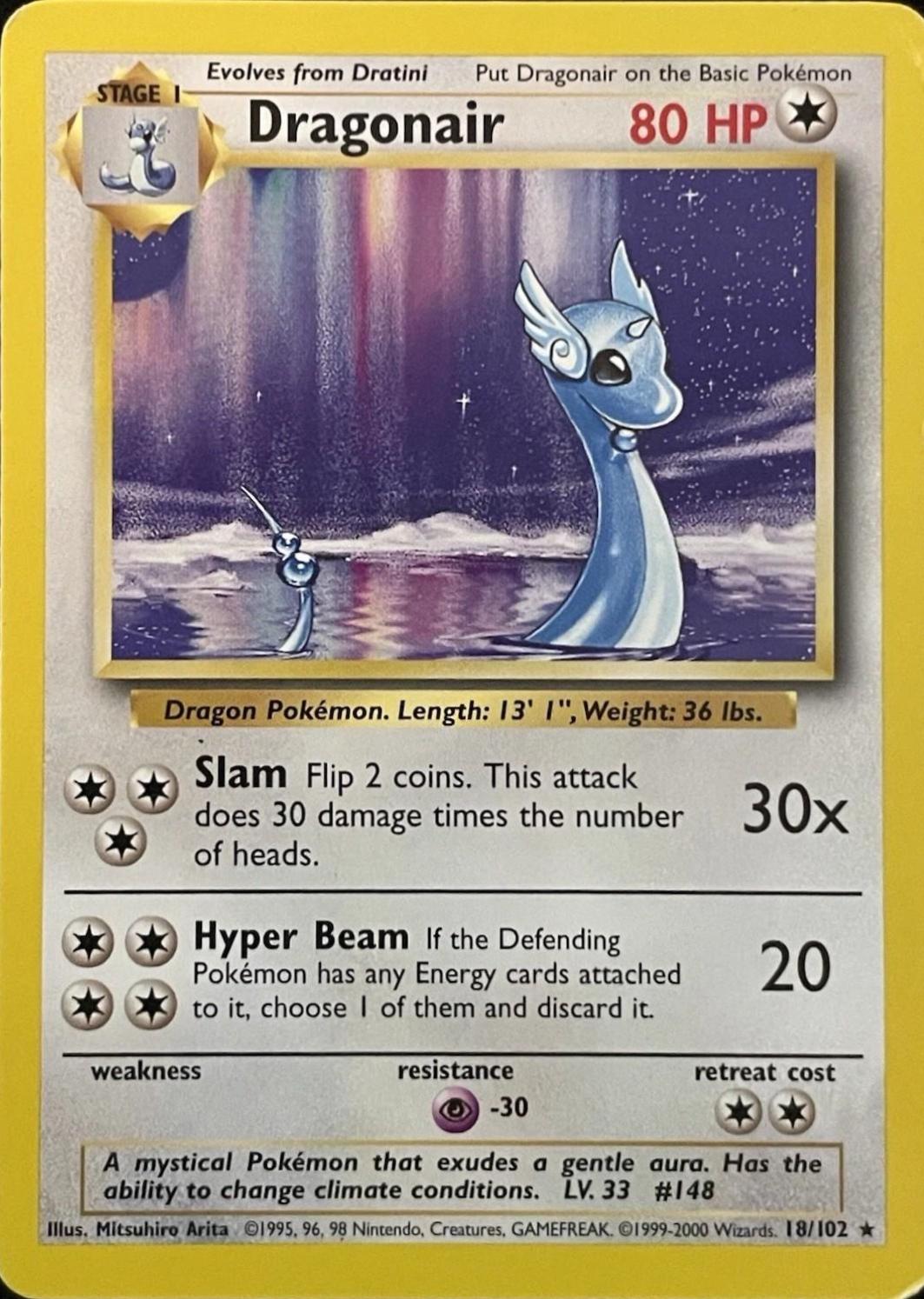
Dragonair is the one card in this block carrying a genuinely documented 1st Edition misprint: the Rainbow Smear, an obstruction in the black ink layer that swallows a letter inside the card text. It is also the middle of Base Set’s only dragon line, and the line stops one stage short of its famous endpoint. Art by Mitsuhiro Arita.
This page covers the 1st Edition printing specifically — the stamped, shadowless-stock version from the original January 1999 run. If you are unsure which of the Base Set Dragonair printings you own, the 3-second test below settles it before you read any further.
| Grade | Market Price | Share of graded copies |
|---|---|---|
| Ungraded (raw) | $136 | — |
| PSA 7 (NM) | $214 | 13.5% |
| PSA 8 (NM-MT) | $312 | 21.2% |
| PSA 9 (Mint) | $584 | 36.7% |
| PSA 10 (Gem Mint) | $5,000 | 8.1% |
| Grade 6 or below | — | 20.4% |
Prices and population shares: the Cards Worth Chasing ranking, PSA only, September 2026. Shares are of all PSA-graded copies of this card, so they sum to 100% with the grade-6-and-below row. Grading cost basis $59.99 (PSA Standard). Comps move — verify current sold prices before transacting.
Live Now on eBay: 1st Edition Dragonair
What the card is actually being offered for right now. Every listing below is filtered to the genuine 1st Edition card — no repacks, mystery slabs, card skins, or multi-card lots. These are asking prices, not sold comps, so treat them as the top of the market rather than what copies are changing hands for. Buying through these links supports the site at no extra cost to you.
Loading current listings…
Which One Do You Have? The 3-Second Test
Most people who say “I have a 1st Edition Dragonair” don’t. Retail packs in 1999–2000 were overwhelmingly Unlimited printing — and that’s fine, it’s the same iconic card. The fast check, in order:
- Right edge of the art box: a dark drop shadow = Unlimited or 4th Print. No shadow = keep going.
- Left of the art box: a black “Edition 1” stamp = 1st Edition. No stamp + no shadow = Shadowless.
- Bottom copyright line: ©1999-2000 = 4th Print. The font weight is the tiebreaker — thin HP text means an early print.
Dragonair is a Stage 1 Colorless with 80 HP, evolving from Dratini, illustrated by Mitsuhiro Arita. On a card at this price point, buy the copy rather than the grade — centering is the usual failure on Dragonair, so check the borders before anything else.
Click to enlarge
 Click to enlarge
 Click to enlarge
 Click to enlarge
PSA 8 prices from PriceCharting sold-comp data, September 2026. Unlimited and 4th Print look nearly identical — the copyright year is the difference. Each printing is its own card with its own price and history; see every printing: 1st Edition · Shadowless · Unlimited · 4th Print.
About This Card and Set
Dragonair is card 18/102, one of the sixteen non-holo Rares in the English Base Set, and the 1st Edition is the scarcest way to own it. Wizards of the Coast released the set on 9 January 1999, and that first run carried a small black “Edition 1” stamp to the lower left of the artwork, printed on what collectors call shadowless stock: no drop shadow behind the art box, and thinner HP and attack text than every later run.
Dragonair sits in the middle of the Dratini, Dragonair and Dragonite line — the only genuine Dragon family in Red & Blue, and the reason the word “rare” carries weight in this corner of the set. Dratini was obtainable only by fishing the Safari Zone with a Super Rod or by buying one with Game Corner coins, and it grew into Dragonair and then Dragonite only at levels 30 and 55. Base Set translated that scarcity selectively: Dratini appears as an Uncommon, Dragonair as a Rare, and Dragonite was held back entirely until Fossil, leaving the first English set with the front two-thirds of the line.
The anime added its own layer. Clair’s Dratini evolves into Dragonair in “Beauty is Skin Deep” after she shields it from a stray attack, and an earlier episode placed a Dratini in the care of a Safari Zone warden. Among error collectors the 1st Edition card has a nickname of its own: the Rainbow Smear Dragonair.
It was reprinted in Base Set 2 in 2000 as card 22/130, a set with no 1st Edition or Shadowless run at all, which is why the stamped Base Set copy remains the one that matters.
How Rare Is This Card?
Start with the two numbers that describe the whole card: roughly 1,663 graded copies exist in PSA, and about 135 of those are PSA 10s. That is a gem rate near 8.1% — and the gem rate, not the raw population, is the number a collector should actually read. High-grade supply is what the market pays for.
| Card | PSA 10s | Total graded | Gem rate |
|---|---|---|---|
| 1st Edition Dragonair (1999) | ~135 | ~1,663 | 8.1% |
| Charizard ex #199, S&V 151 (2023) | 29,679 | 102,490 | ~29% |
PriceCharting population data, September 2026. The modern row is a combined PSA + CGC count; the 1999 row is PSA, the way it is normally quoted.
For scale, compare it with the modern equivalent: a comparable modern chase card carries a gem rate near 29%. Modern cards grade far better than vintage ones — not because they are better cards, but because a 1999 card was printed before grading was mainstream and then spent two decades in a binder. A vintage gem count is not comparable to a modern one.
Dragonair pairs a large graded census with a low raw price — an uncommon shape among the set’s harder-to-find cards, and the reason clean copies are easy to source without paying holo money.
Population source: PriceCharting, September 2026, PSA column only. Two caveats stay attached to every population figure on this site. Graded counts are submission tallies, not unique cards — resubmissions inflate the total, so the number of genuinely distinct gem copies is lower. And the census is a floor, not a final number: it grows with every submission wave.
Known Error Cards
One error is documented on the 1st Edition printing, and it gives the card its nickname: the Rainbow Smear Dragonair. An obstruction in the black ink layer swallows the letter “u” in the word “number” inside one of the card’s descriptions, in a location that repeats with unusual consistency. Bulbapedia lists it for the 1st Edition and Shadowless prints; Elite Fourum’s base-set misprint guide files the same defect as a black-layer obstruction on those two printings; and the Elite Fourum corrected-errors master guide lists it as the Rainbow Ink Smear, Dragonair 18/102. CGC labels the variant “Rainbow” Ink Smear, and Heritage Auctions has catalogued a 1st Edition Dragonair 18 with the error at CGC 8. PSA does not recognise it.
The other Dragonair errors sit on the Unlimited printing, not this one: a gold border printer hickey, recorded as the Dragon Ballz Dragonair. The name “Rainbow” is a collector handle rather than a description of the press fault, and the error appears on Shadowless copies too — it is not exclusive to the 1st Edition.
What Makes This Card Collectible?
Dragonair is collected for two genuinely different reasons, and both are specific to this card:
- A real, documented 1st Edition error. The Rainbow Smear is one of the few catalogued misprints that sits on the 1st Edition printing rather than on Unlimited.
- A line the set never finished. Dratini and Dragonair both appear in Base Set; Dragonite was held back until Fossil, which closes the pair.
- CGC recognises it and PSA does not. The same copy can carry an error designation from one grader and a plain grade from the other.
You do not need the most expensive card in the set to own the set's artwork. The Base Set hub lays out the whole run, and the 1st Edition printing hub covers what makes this print different.
The Artist: Mitsuhiro Arita
Mitsuhiro Arita is one of the illustrators who defined the look of the original English Pokémon TCG, and Dragonair is one of their Base Set contributions. This section will carry their full numbers when the artist guide lands — how many cards they illustrated across the Wizards era and what one raw copy of each would cost.
Caleb's Collector Verdict
Dragonair is the rare card in this block that justifies the nickname: a real, grader-recognised 1st Edition misprint on a cheap card, sitting at the end of the one dragon line Base Set never completed.
People Also Ask
Is my 1st Edition Dragonair real or fake?
The 1999 Base Set cards are the most counterfeited in the hobby, and for a raw copy worth real money you cannot settle it from a photo. The checks that catch most fakes: the light test (a genuine card is essentially opaque — a faint dark core line between the layers; cheap fakes glow through), the stamp rule (a real 1st Edition stamp is crisp and sits under the ink, and counterfeiters add stamps to Unlimited cards — read it with the drop shadow and the 1995-99 copyright line, never alone), and the back (fakes perfect the front and neglect the Poké Ball, the blue tone and the repeated text). Above a few hundred dollars, a raw copy should get professional pre-authentication. The full fake-detection walkthrough covers all of it.
Should I grade this card?
Dragonair is the rare Base Set card where the odds genuinely support grading: the gem rate is high enough that a sharp copy is a real contender, and the low raw cost means the fee is a large share of the money at stake. See Should You Grade Pokémon Cards? for the fee maths, and check a raw copy with the CardGrader scanner before sending it in.