
Venusaur 1st Edition Base Set: Arita's Original
Reviewed by Caleb Stapel · Collector · Updated September 2026
Venusaur is the deepest-graded of the three starter holos and the card whose gem population is easiest to find in the set. Raw copies trade around $1,148, while a PSA 10 gem has cleared $37,210 — the gap between those two numbers is the whole story of this card.
This page covers the 1st Edition printing specifically — the stamped, shadowless-stock version from the original January 1999 run. If you are unsure which of the Base Set Venusaur printings you own, the 3-second test below settles it before you read any further.
| Grade | Market Price | Share of graded copies |
|---|---|---|
| Ungraded (raw) | $1,148 | — |
| PSA 7 (NM) | $2,490 | 13.0% |
| PSA 8 (NM-MT) | $4,054 | 16.7% |
| PSA 9 (Mint) | $5,927 | 20.4% |
| PSA 10 (Gem Mint) | $37,210 | 4.1% |
| Grade 6 or below | — | 45.7% |
Prices and population shares: the Cards Worth Chasing ranking, PSA only, September 2026. Shares are of all PSA-graded copies of this card, so they sum to 100% with the grade-6-and-below row. Grading cost basis $59.99 (PSA Standard). Comps move — verify current sold prices before transacting.
Live Now on eBay: 1st Edition Venusaur
What the card is actually being offered for right now. Every listing below is filtered to the genuine 1st Edition card — no repacks, mystery slabs, card skins, or multi-card lots. These are asking prices, not sold comps, so treat them as the top of the market rather than what copies are changing hands for.
Loading current listings…
Which One Do You Have? The 3-Second Test
Most people who say “I have a 1st Edition Venusaur” don’t. Retail packs in 1999–2000 were overwhelmingly Unlimited printing — and that’s fine, it’s the same iconic card. The fast check, in order:
- Right edge of the art box: a dark drop shadow = Unlimited or 4th Print. No shadow = keep going.
- Left of the art box: a black “Edition 1” stamp = 1st Edition. No stamp + no shadow = Shadowless.
- Bottom copyright line: ©1999-2000 = 4th Print. The font weight is the tiebreaker — thin HP text means an early print.
Venusaur is a Stage 2 Grass-type evolving from Ivysaur, and one of only three Base Set holos drawn by Mitsuhiro Arita, alongside Charizard and Gyarados. Unlike most holos, its art is original to the card.
Click to enlarge
 Click to enlarge
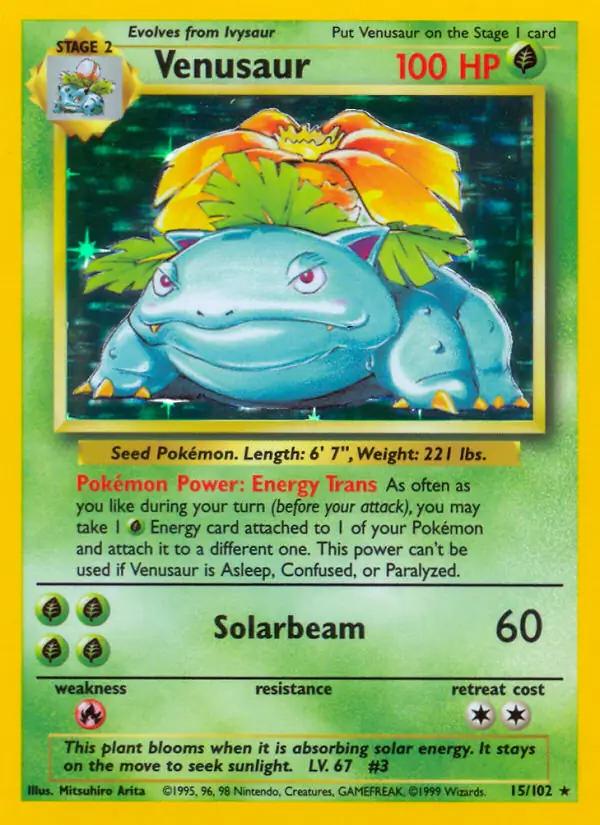 Click to enlarge
 Click to enlarge
PSA 8 prices from PriceCharting sold-comp data, September 2026. Unlimited and 4th Print look nearly identical — the copyright year is the difference. Each printing is its own card with its own price and history; see every printing: 1st Edition · Shadowless · Unlimited · 4th Print.
About This Card and Set
Venusaur #15/102 is one of the sixteen holographic rares in the 1999 English Base Set — Wizards of the Coast’s first Pokémon TCG release, which reached North America on January 9, 1999. It carries the same rarity and the same scarce 1st Edition print run as Charizard and Blastoise, the trio collectors shorthand as the “Big Three.” Yet Venusaur has spent more than twenty-five years as the overlooked member of that group: identical scarcity, a fraction of the attention.
That reputation traces back to the games. Venusaur’s line opens the Pokédex, and in the original Red and Green its Grass starter made the early gyms genuinely easy — an advantage that somehow read as boring beside Charmander’s fire. In Japan, Venusaur headlined the box art of Pokémon Green; for the Western release it was swapped out for Blastoise.
The Japanese Base Set, released October 20, 1996, is the true first printing, and its earliest “No Rarity” copies — named for the rarity symbol they lack — are among the first Pokémon cards ever made. The No Rarity Venusaur famously misprints its Pokédex number as “No.068” instead of No.003. The English 1st Edition, stamped “Edition 1” beside the artwork, inherited that origin story — and finally had its market moment when a Venusaur pulled in Logan Paul’s 2026 box break graded PSA 10 and sold at Goldin, reported as a record for the card in any language.
How Rare Is This Card?
Start with the two numbers that describe the whole card: roughly 4,009 graded copies exist in total, and about 172 of those are PSA 10s. That is a gem rate near 4.3% — and the gem rate, not the raw population, is the number a collector should actually read. High-grade supply is what the market pays for.
| Card | PSA 10s | Total graded | Gem rate |
|---|---|---|---|
| 1st Edition Venusaur (1999) | ~172 | ~4,009 | 4.3% |
| Charizard ex #199, S&V 151 (2023) | 29,679 | 102,490 | ~29% |
PriceCharting population data, September 2026. The modern row is a combined PSA + CGC count; the 1999 row is PSA, the way it is normally quoted.
For scale, compare it with for scale, take a modern chase card printed and slabbed within a year of release: it can carry tens of thousands of gem-grade copies against a gem rate near 29%. The modern card has many times this card’s gem supply at several times its gem rate, not because it is a better card, but because a 1999 card was printed before grading was mainstream and then spent two decades in a binder, on a card printed and slabbed within a year of release. The modern card has many times the gem supply, at several times this card's gem rate — not because it is a better card, but because a 1999 card was printed before grading was mainstream and then spent two decades in a binder. A vintage gem count is not comparable to a modern one.
Population source: PriceCharting, September 2026. The vintage figure is PSA; the modern figure is a combined PSA + CGC count, which is how each is normally quoted.
Two caveats stay attached to every population figure on this site. Graded counts are submission tallies, not unique cards — resubmissions inflate the total, so the number of genuinely distinct gem copies is lower. And the census is a floor, not a final number: it grows with every submission wave.
Known Error Cards
No error is documented as unique to — or named for — the English 1st Edition Venusaur. The famous “Blue Drip Venusaur,” scattered blue ovals of missing yellow ink left by a water-drip obstruction on the yellow plate, belongs to the Unlimited printing. A one-of-a-kind “Tape Obstruction Venusaur” appears only as an honourable mention. Bulbapedia and Elite Fourum’s Base Set misprint guide agree the Venusaur-specific ink errors sit outside 1st Edition entirely.
What the 1st Edition Venusaur does share is the run-wide stamp variation: Base Set 1st Edition holos turn up with thick stamps, thin stamps, and the pale “grey stamp” left by under-inked or smudged stamping. Grey stamps are noted as extremely hard to find on the set’s rares, placing a grey-stamped 1st Edition Venusaur among the tougher copies to source.
What Makes This Card Collectible?
Venusaur is the value-priced starter, and its case rests on being original artwork by the hand that drew Charizard.
- Arita, not Sugimori reuse. One of only three Base Set holos drawn fresh for the set — the artist who also drew Charizard.
- The error-free printing. The only repeating Venusaur misprint is Unlimited-only, a counter-intuitive and checkable distinction.
- A booster-pack face. Venusaur is one of the three English Base Set pack and box artworks, with Charizard and Blastoise.
- Deepest starter gem count. About 145 PSA 10s — the most forgiving of the three starters to grade.
The Base Set hub sets it against the other two starters, and the Unlimited printing is the inexpensive copy of the same Arita illustration.
The Artist: Mitsuhiro Arita
Mitsuhiro Arita (b. 1971, Fukuoka) joined the TCG at its 1996 prototype and drew three Base Set holos — Charizard #4, Gyarados #6 and Venusaur #15. He has described the early team having no art director, working from Game Boy sprites and inventing their own backgrounds. Venusaur is his original composition, creature and environment drawn together, not a reused watercolour.
Caleb's Collector Verdict
Venusaur is the value-priced starter: the same tier of recognition as the other two, drawn by the artist behind Charizard, with the most forgiving grading odds and the most moderate price.
People Also Ask
Is my 1st Edition Venusaur real or fake?
The 1999 Base Set holos are the most counterfeited cards in the hobby, and for a raw copy worth real money you cannot settle it from a photo. The checks that catch most fakes: the light test (a genuine card is essentially opaque — a faint dark core line between the layers; cheap fakes glow through), the stamp rule (a real 1st Edition stamp is crisp and sits under the ink, and counterfeiters add stamps to Unlimited cards — but a faint grey “ghost” stamp can be an authentic variant, so read it with the shadow and the 1995-99 copyright line, never alone), and the back (fakes perfect the front and neglect the Poké Ball, the blue tone and the repeated text). Above a few hundred dollars, a raw copy should get professional pre-authentication. The full fake-detection walkthrough covers all of it with the CGC forensic case study.
Should I grade this card?
Yes — and Venusaur is the most forgiving of the three starters to grade. With roughly 172 PSA 10s, the largest gem population among the starters, a high-grade return is more likely than on a Charizard. That cuts both ways: the resulting gem is less scarce, but the grading decision is easier to justify. See Should You Grade Pokémon Cards? for the fee maths, and check a raw copy with the CardGrader scanner before sending it in.