
Revive 1st Edition Base Set: The Kinebuchi Trainer
Reviewed by Caleb Stapel · Collector · Updated September 2026
Revive is the quiet workhorse of Base Set's Trainer aisle, a 1999 Uncommon whose real first edition is arguably Japanese — the 1996 no-rarity print. Kinebuchi, the game's pioneering 3D illustrator, gave it the era's clean machine-made look, and it has been reissued ever since, in Nivi City Gym decks, Black & White, Roaring Skies and Evolutions. Raw Near Mint copies trade around $19, while a PSA 10 reaches $451.
This page covers the 1st Edition printing specifically — the stamped, shadowless-stock version from the original January 1999 run. If you are unsure which of the Base Set Revive printings you own, the 3-second test below settles it before you read any further.
| Grade | Market Price | Share of graded copies |
|---|---|---|
| Ungraded (raw) | $19 | — |
| PSA 7 (NM) | $36 | 5.7% |
| PSA 8 (NM-MT) | $45 | 20.9% |
| PSA 9 (Mint) | $160 | 43.8% |
| PSA 10 (Gem Mint) | $451 | 22.5% |
| Grade 6 or below | — | 7.1% |
Prices and population shares: the Cards Worth Chasing ranking, PSA only, September 2026. Shares are of all PSA-graded copies of this card, so they sum to 100% with the grade-6-and-below row. Grading cost basis $59.99 (PSA Standard). Comps move — verify current sold prices before transacting.
Live Now on eBay: 1st Edition Revive
What the card is actually being offered for right now. Every listing below is filtered to the genuine 1st Edition card — no repacks, mystery slabs, card skins, or multi-card lots. These are asking prices, not sold comps, so treat them as the top of the market rather than what copies are changing hands for. Buying through these links supports the site at no extra cost to you.
Loading current listings…
Which One Do You Have? The 3-Second Test
Most people who say “I have a 1st Edition Revive” don’t. Retail packs in 1999–2000 were overwhelmingly Unlimited printing — and that’s fine, it’s the same iconic card. The fast check, in order:
- Right edge of the art box: a dark drop shadow = Unlimited or 4th Print. No shadow = keep going.
- Left of the art box: a black “Edition 1” stamp = 1st Edition. No stamp + no shadow = Shadowless.
- Bottom copyright line: ©1999-2000 = 4th Print. The font weight is the tiebreaker — thin text means an early print.
Revive is an Trainer, illustrated by Keiji Kinebuchi. On a raw copy, confirm the black Edition 1 circle stamp sits just below and left of the art box, that the copyright line still carries the ’99’ year, and that the stamp is solid black rather than grey, thin or smeared — the printer-pressure quirks that separate a clean 1st Edition from a print-anomaly copy.
The four printings of Base Set each have their own price and history: 1st Edition · Shadowless · Unlimited · 4th Print.
Click to enlarge
 Click to enlarge
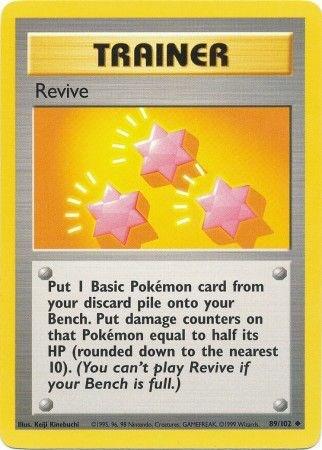 Click to enlarge
 Click to enlarge
PSA 8 prices from PriceCharting sold-comp data, September 2026. Unlimited and 4th Print look nearly identical — the copyright year is the difference. Each printing is its own card with its own price and history; see every printing: 1st Edition · Shadowless · Unlimited · 4th Print.
About This Card and Set
Revive began not in an English booster pack but in Japan's October 1996 Expansion Pack, printed without a rarity symbol — the tell of the set's true first print run. When Wizards of the Coast brought Base Set to America on January 9, 1999, card 89/102 returned as an Uncommon Trainer, illustrated by Keiji Kinebuchi, the 3D artist whose LightWave-rendered objects gave the earliest Trainers their clean, desktop-computer look. Collectors now chase that Japanese no-rarity print as Revive's genuine first edition, the original the English 1st Edition stamp only echoes.
Kinebuchi drew most early Trainer art and personally recommended Mitsuhiro Arita to the project; he died around 2002, so anything credited to him afterward reuses existing work. Revive outlived him repeatedly: a Japanese Nivi City Gym deck reprint, then Black & White reclassified it from Trainer to Item, Roaring Skies commissioned fresh art from Toyste Beach, and Evolutions restored Kinebuchi's original image for the twentieth anniversary. On the 1st Edition sheet it sat among the uncommons, and because Trainers carry no illustration window, its shadowless status has to be read from the copyright line. For a generation raised sorting Base Set bulk on bedroom floors, the Kinebuchi Trainer aisle — Potion, Switch, Pokédex, Revive — is its own flavor of nostalgia, machine-made and unmistakably 1999.
How Rare Is This Card?
Start with the number that describes the whole card: roughly 1,115 graded copies exist in total, and ~251 of those are PSA 10s. That is a gem rate of about 22.5% — and the gem rate, not the raw population, is what a collector should actually be reading. High-grade supply is what the market pays for.
| Card | PSA 10s | Total graded | Gem rate |
|---|---|---|---|
| Revive 1st Edition (1999) | ~251 | ~1,115 | ~22.5% |
| Charizard ex #199, S&V 151 (2023) | 29,679 | 102,490 | ~29% |
PriceCharting population data, September 2026. The modern row is a combined PSA + CGC count; the 1999 row is PSA, the way it is normally quoted.
Revive’s graded population is mid-sized, and about a fifth of submitted copies reach PSA 10.
The card’s appeal is its unusually deep reprint history and a Japanese no-rarity ancestor that predates the English stamp entirely.For scale, a comparable modern chase card converts to a gem grade at roughly 29%. Modern cards grade far better than vintage ones — not because they are better cards, but because a 1999 card was printed before grading was mainstream and then spent two decades in a binder.
Source: the PSA-only figures behind the Cards Worth Chasing ranking, September 2026. Two caveats stay attached to every population figure on this site. Graded counts are submission tallies, not unique cards — resubmissions inflate the total. And the census is a floor, not a final number.
Known Error Cards
No Revive-specific error appears in Bulbapedia's Error cards list, PSA's Pokémon Error Guide, PokeBeach's misprint database, or the Elite Fourum Base Set misprint guide — so a 1st Edition Revive carries no known card-unique flaw. What does apply is printing-wide: Bulbapedia notes 1st Edition commons and uncommons with smeared, misaligned or partially transferred front stamps, and Elite Fourum documents grey 1st Edition stamps plus ink imprints of the stamp on the card back, all caused by insufficient or undried black ink. Revive, an Uncommon, is eligible for these. The famous Base Set errors — Blastoise's missing ‘Stage’, the Wartortle evolution box, Diglett's sideways Fighting symbol, and No Damage Ninetales — are Unlimited or Shadowless only and never belong on a 1st Edition page.
What Makes This Card Collectible?
Three things decide whether a Revive is worth keeping, and only one of them is condition.
- Stamp diagnosis. A 1st Edition Revive must show the black Edition 1 circle below and left of the art box, with a solid black stamp rather than the grey or thin impressions seen on some first-run cards.
- Printing separator. Because Trainers have no illustration window, telling a Shadowless Revive from an Unlimited one comes down to the copyright line — ’99’ present means Shadowless, absent means Unlimited.
- Reprint ceiling. Revive returned in Evolutions with Kinebuchi's original art, so the 1st Edition remains the scarce vintage anchor that a retro reprint can echo but never replace.
Get the printing right first, and the rest follows.
The Artist: Keiji Kinebuchi
Keiji Kinebuchi is one of the illustrators who defined the look of the original English Pokémon TCG, and Revive is one of their Base Set contributions. This section will carry their full numbers when the artist guide lands.
Caleb's Collector Verdict
Revive is a Base Set Uncommon with an unusually deep reprint history and an ancestor in Japan's no-rarity first print.
People Also Ask
Is my 1st Edition Revive real or fake?
The 1999 Base Set cards are the most counterfeited in the hobby, and for a raw copy worth real money you cannot settle it from a photo. The checks that catch most fakes: the light test (a genuine card is essentially opaque — a faint dark core line between the layers; cheap fakes glow through), the stamp rule (a real 1st Edition stamp is crisp and sits under the ink, and counterfeiters add stamps to Unlimited cards — read it with the drop shadow and the 1995-99 copyright line, never alone), and the back (fakes perfect the front and neglect the Poké Ball, the blue tone and the repeated text). Above a few hundred dollars, a raw copy should get professional pre-authentication. The full fake-detection walkthrough covers all of it.
Should I grade this card?
Grading makes sense mainly for a true 1st Edition: with raw Near Mint copies around $19 and a PSA 10 at $451, the spread is wide enough to reward a clean submission. Roughly 2,053 Revives have been graded across PSA and SGC, with about 460 earning PSA 10, so gems are attainable but not automatic. A low-grade or Unlimited copy usually is not worth the fee.