
Potion 1st Edition Base Set: The Original 3D Trainer
Reviewed by Caleb Stapel · Collector · Updated September 2026
Potion is the quiet workhorse of 1st Edition Base Set — a Common that every player owned and almost nobody preserved. Keiji Kinebuchi’s low-polygon 3D bottle became the visual shorthand for healing across the whole TCG, and this is its first English printing, carrying the black Edition 1 stamp on the shadowless template. Raw near-mint copies trade around $17, while a PSA 10 sells for about $504.
This page covers the 1st Edition printing specifically — the stamped, shadowless-stock version from the original January 1999 run. If you are unsure which of the Base Set Potion printings you own, the 3-second test below settles it before you read any further.
| Grade | Market Price | Share of graded copies |
|---|---|---|
| Ungraded (raw) | $17 | — |
| PSA 7 (NM) | $18 | 7.1% |
| PSA 8 (NM-MT) | $37 | 18.0% |
| PSA 9 (Mint) | $100 | 42.1% |
| PSA 10 (Gem Mint) | $504 | 25.0% |
| Grade 6 or below | — | 7.8% |
Prices and population shares: the Cards Worth Chasing ranking, PSA only, September 2026. Shares are of all PSA-graded copies of this card, so they sum to 100% with the grade-6-and-below row. Grading cost basis $59.99 (PSA Standard). Comps move — verify current sold prices before transacting.
Live Now on eBay: 1st Edition Potion
What the card is actually being offered for right now. Every listing below is filtered to the genuine 1st Edition card — no repacks, mystery slabs, card skins, or multi-card lots. These are asking prices, not sold comps, so treat them as the top of the market rather than what copies are changing hands for. Buying through these links supports the site at no extra cost to you.
Loading current listings…
Which One Do You Have? The 3-Second Test
Most people who say “I have a 1st Edition Potion” don’t. Retail packs in 1999–2000 were overwhelmingly Unlimited printing — and that’s fine, it’s the same iconic card. The fast check, in order:
- Right edge of the art box: a dark drop shadow = Unlimited or 4th Print. No shadow = keep going.
- Left of the art box: a black “Edition 1” stamp = 1st Edition. No stamp + no shadow = Shadowless.
- Bottom copyright line: ©1999-2000 = 4th Print. The font weight is the tiebreaker — thin text means an early print.
Potion is an Trainer, illustrated by Keiji Kinebuchi. Inspect the black Edition 1 stamp first — Trainers are the cards most prone to smudged, gray or low-ink stamps — then confirm there is no drop shadow on the art box and that the copyright line carries the extra ‘99’, the tells that separate a true 1st Edition from Shadowless and Unlimited.
The four printings of Base Set each have their own price and history: 1st Edition · Shadowless · Unlimited · 4th Print.
Click to enlarge
 Click to enlarge
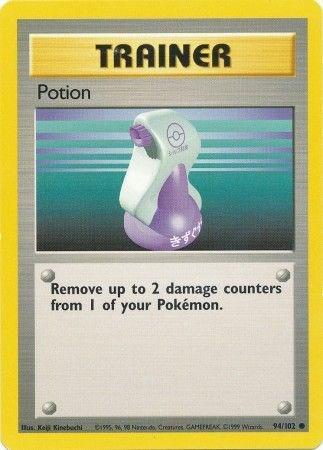 Click to enlarge
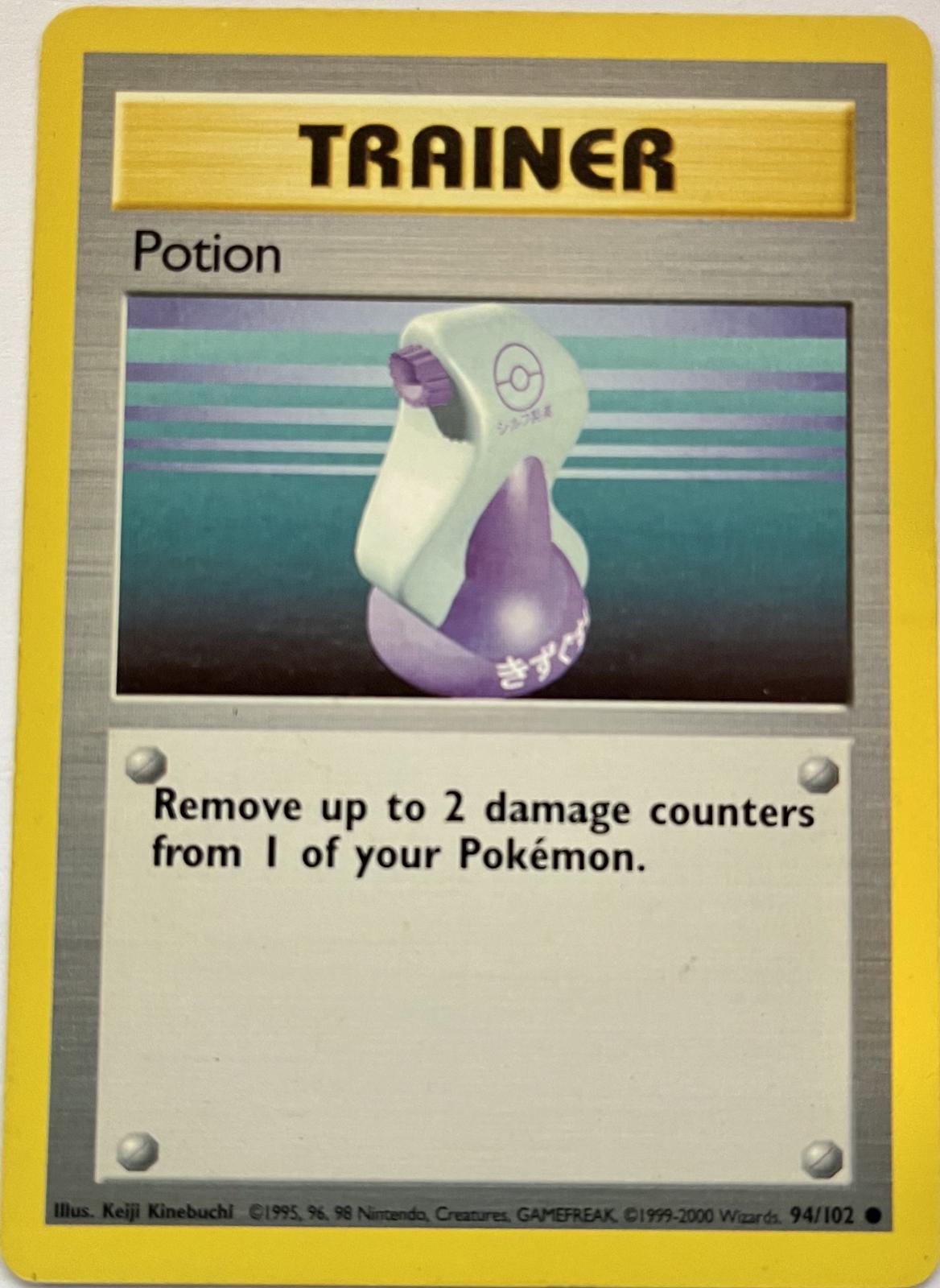 Click to enlarge
PSA 8 prices from PriceCharting sold-comp data, September 2026. Unlimited and 4th Print look nearly identical — the copyright year is the difference. Each printing is its own card with its own price and history; see every printing: 1st Edition · Shadowless · Unlimited · 4th Print.
About This Card and Set
Potion got to players before the English game existed. It debuted in Japan’s Expansion Pack, and while Wizards of the Coast was still testing whether a Pokémon card game could work, prototype Pokémon Leagues were handed Trainer Deck A — a red-bordered deck with “Trainer Deck A” printed on the back — and Potion was inside it. The 1st Edition Base Set printing is a card with pre-release ancestry: shipped in the first English booster run, stamped Edition 1, and built on the shadowless template. It was the cheapest, most disposable card in the set, which is exactly why clean copies are the scarce ones today. Nobody sleeved a Potion.
The art is design history more than illustration. Keiji Kinebuchi built his images as 3D models in LightWave and finished them in Photoshop, which is why the bottle carries flat studio lighting and sits in no particular place. He designed the layout of every Basic Energy card, and Mitsuhiro Arita has said Kinebuchi designed the cards the energy symbols sat on. Kinebuchi also brought Arita into the project: the man who drew Base Set Charizard was recommended by the man who drew the Potion. Reprints kept the picture but changed its framing — Base Set 2 (122/130) and Legendary Collection (110/110) reused the original text, and the card was later reclassified from Trainer to Item. Kinebuchi died around 2002, and reprints kept carrying his name long after new credits stopped.
How Rare Is This Card?
Start with the number that describes the whole card: roughly 1,151 graded copies exist in total, and ~288 of those are PSA 10s. That is a gem rate of about 25.0% — and the gem rate, not the raw population, is what a collector should actually be reading. High-grade supply is what the market pays for.
| Card | PSA 10s | Total graded | Gem rate |
|---|---|---|---|
| Potion 1st Edition (1999) | ~288 | ~1,151 | ~25.0% |
| Charizard ex #199, S&V 151 (2023) | 29,679 | 102,490 | ~29% |
PriceCharting population data, September 2026. The modern row is a combined PSA + CGC count; the 1999 row is PSA, the way it is normally quoted.
Potion has one of the deepest populations in the set, and roughly thirty percent of graded copies reach PSA 10.
The premium sits entirely at the top grade; raw copies are the most common card in Base Set and are collected for their printing tells.For scale, a comparable modern chase card converts to a gem grade at roughly 29%. Modern cards grade far better than vintage ones — not because they are better cards, but because a 1999 card was printed before grading was mainstream and then spent two decades in a binder.
Source: the PSA-only figures behind the Cards Worth Chasing ranking, September 2026. Two caveats stay attached to every population figure on this site. Graded counts are submission tallies, not unique cards — resubmissions inflate the total. And the census is a floor, not a final number.
Known Error Cards
Potion’s documented production quirks are 1st Edition stamp anomalies rather than artwork or text errors, and they belong to the 1st Edition printing. Bulbapedia’s Error cards page records that non-holo Base Set 1st Editions turn up with smudged, gray or low-ink Edition 1 stamps, and that Trainer cards are the type most affected — a class this card belongs to. The same page lists 1st Edition commons and uncommons with an inverted Edition 1 stamp transferred onto the card back, plus white-stamp variants where that transfer stripped ink. Elite Fourum’s English Base Set Master Misprint Guide groups the same material as grey 1st edition stamps, black and white back-imprinted stamps, and thin non-holo stamps, and notes that 1999 grayscale fillers have surfaced from 1st Edition, Shadowless and Unlimited runs alike. PSA’s Pokémon Error Guide documents no Potion-specific error, and PokeBeach’s error database lists none either.
What Makes This Card Collectible?
Potion sits at the bottom of Base Set and, quietly, at the top of its own small category: the entry-level Trainer that outlasted almost everything printed beside it.
- Trainer Deck A. Before the English TCG launched, prototype Pokémon Leagues received a red-bordered Trainer Deck A that included this card, giving Potion a paper trail older than Base Set itself.
- The Kinebuchi line. The bottle is 3D work by Keiji Kinebuchi, the artist who designed the Basic Energy layouts and introduced Mitsuhiro Arita to the project.
- Reprinted and reclassified. The same image returned in Base Set 2 and Legendary Collection before the card was moved from Trainer to Item in later sets.
It is the rare case where the entry-level card is also the historically loaded one.
The Artist: Keiji Kinebuchi
Keiji Kinebuchi is one of the illustrators who defined the look of the original English Pokémon TCG, and Potion is one of their Base Set contributions. This section will carry their full numbers when the artist guide lands.
Caleb's Collector Verdict
Potion is the most honest card in Base Set: a common you probably owned, in a printing most people threw away.
People Also Ask
Is my 1st Edition Potion real or fake?
The 1999 Base Set cards are the most counterfeited in the hobby, and for a raw copy worth real money you cannot settle it from a photo. The checks that catch most fakes: the light test (a genuine card is essentially opaque — a faint dark core line between the layers; cheap fakes glow through), the stamp rule (a real 1st Edition stamp is crisp and sits under the ink, and counterfeiters add stamps to Unlimited cards — read it with the drop shadow and the 1995-99 copyright line, never alone), and the back (fakes perfect the front and neglect the Poké Ball, the blue tone and the repeated text). Above a few hundred dollars, a raw copy should get professional pre-authentication. The full fake-detection walkthrough covers all of it.
Should I grade this card?
Grading a Potion only makes sense because the raw card is so cheap — at around $17 near-mint, the submission fee is a real fraction of the card’s value. PSA 10 examples sell for about $504, and roughly 30% of graded Potions have reached that gem grade, so the upside exists but is common enough to blunt the gamble. Send one in only if the corners and the Edition 1 stamp are visibly flawless.