
Machamp 1st Edition Base Set: The Set's Most Printed Holo
Reviewed by Caleb Stapel · Collector · Updated September 2026
Machamp is the only Base Set holo that was never printed Unlimited, and the set's hardest card to find in gem condition. Raw copies trade around $13, while a PSA 10 gem has cleared $4,829 — the gap between those two numbers is the whole story of this card.
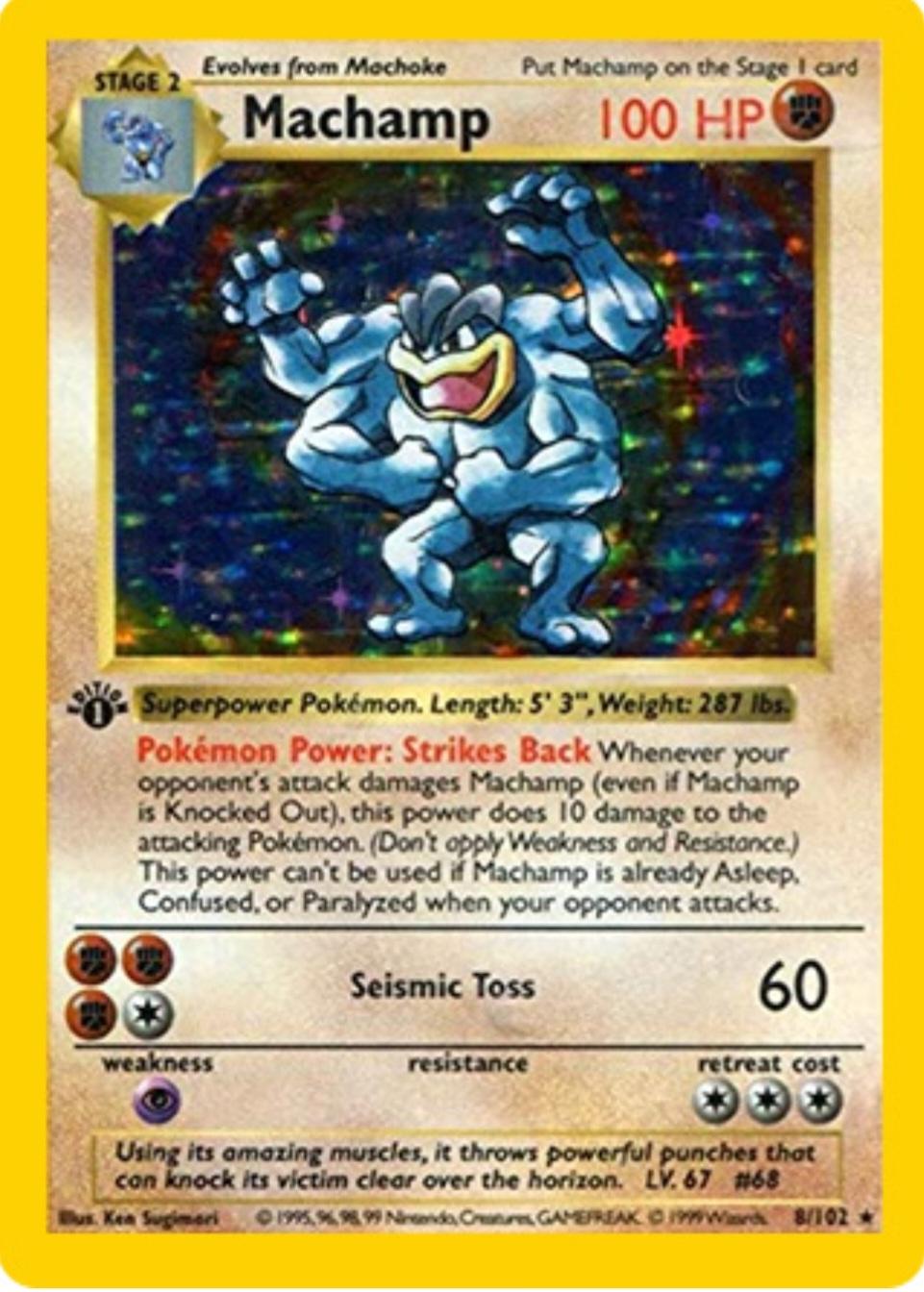
This page covers the 1st Edition printing — the only printing Machamp ever had. It was a 2-Player Starter Set exclusive and was never released Unlimited, so there is no cheaper version to compare against. The 3-second test below confirms what you have before you read further.
| Grade | Market Price | Share of graded copies |
|---|---|---|
| Ungraded (raw) | $15 | — |
| PSA 7 (NM) | $75 | 14.8% |
| PSA 8 (NM-MT) | $128 | 13.1% |
| PSA 9 (Mint) | $241 | 6.1% |
| PSA 10 (Gem Mint) | $4,651 | 0.2% |
| Grade 6 or below | — | 65.8% |
Prices and population shares: the Cards Worth Chasing ranking, PSA only, September 2026. Shares are of all PSA-graded copies of this card, so they sum to 100% with the grade-6-and-below row. Grading cost basis $59.99 (PSA Standard). Comps move — verify current sold prices before transacting.
Live Now on eBay: 1st Edition Machamp
What the card is actually being offered for right now. Every listing below is filtered to the genuine 1st Edition card — no repacks, mystery slabs, card skins, or multi-card lots. These are asking prices, not sold comps, so treat them as the top of the market rather than what copies are changing hands for.
Loading current listings…
Which One Do You Have? The 3-Second Test
Most people who say “I have a 1st Edition Machamp” don’t. Retail packs in 1999–2000 were overwhelmingly Unlimited printing — and that’s fine, it’s the same iconic card. The fast check, in order:
- Right edge of the art box: a dark drop shadow = Unlimited or 4th Print. No shadow = keep going.
- Left of the art box: a black “Edition 1” stamp = 1st Edition. No stamp + no shadow = Shadowless.
- Bottom copyright line: ©1999-2000 = 4th Print. The font weight is the tiebreaker — thin HP text means an early print.
Machamp is a Stage 2 Fighting-type with 100 HP. Crucially: Base Set Machamp was a 2-Player Starter Set exclusive, printed only in the 1st Edition-stamped form. It was never in booster packs and never had a Shadowless or Unlimited printing.
Click to enlarge
 Click to enlarge
 Click to enlarge
PSA 8 prices from PriceCharting sold-comp data, September 2026. Unlimited and 4th Print look nearly identical — the copyright year is the difference. Each printing is its own card with its own price and history; see every printing: 1st Edition · Shadowless · Unlimited · 4th Print.
About This Card and Set
Machamp is card 8/102 and it has the strangest print history of any Base Set holo, because it never came from a booster pack. The entire run went into the 2-Player Starter Set, and every copy carries the 1st Edition stamp — the stamp was simply never taken off the plate. So this is the one Base Set holo where the 1st Edition badge does not signal a scarcer printing.
There is a real “first” hiding in that oddity. The 2-Player Starter Set reached shelves before Base Set boosters did, which makes Machamp the first Pokémon card many English-speaking players ever held. It is the set's teaching card, and it outsold all of them.
The one non-1st-Edition Machamp that exists is Trainer Deck A — a non-holo prototype with a red card back, issued to the earliest Pokémon Leagues before the American launch. It is genuinely rare, and it is the exception that proves the rule. The print structure behind all of this is in the 1st Edition set guide.
How Rare Is This Card?
Start with the two numbers that describe the whole card: roughly 9,262 graded copies exist in total, and about 48 of those are PSA 10s. That is a gem rate near 0.5% — and the gem rate, not the raw population, is the number a collector should actually read. High-grade supply is what the market pays for.
| Card | PSA 10s | Total graded | Gem rate |
|---|---|---|---|
| 1st Edition Machamp (1999) | ~48 | ~9,262 | 0.5% |
| Charizard ex #199, S&V 151 (2023) | 29,679 | 102,490 | ~29% |
PriceCharting population data, September 2026. The modern row is a combined PSA + CGC count; the 1999 row is PSA, the way it is normally quoted.
For scale, compare it with the modern equivalent: a 2023 chase Charizard carries roughly 29,679 gem-grade copies out of about 102,490 graded — a gem rate near 29%, on a card printed and slabbed within a year of release. The modern card has many times the gem supply, at several times this card's gem rate — not because it is a better card, but because a 1999 card was printed before grading was mainstream and then spent two decades in a binder. A vintage gem count is not comparable to a modern one.
Population source: PriceCharting, September 2026. The vintage figure is PSA; the modern figure is a combined PSA + CGC count, which is how each is normally quoted.
Two caveats stay attached to every population figure on this site. Graded counts are submission tallies, not unique cards — resubmissions inflate the total, so the number of genuinely distinct gem copies is lower. And the census is a floor, not a final number: it grows with every submission wave.
Known Error Cards
None are documented for the 1st Edition printing — but Machamp is the one card in the set that is structurally anomalous, so the section cannot be a single line. Every Base Set Machamp carries a 1st Edition stamp, because the card was only ever distributed through the 2-Player Starter Set and the stamp was never removed. Collectors sometimes call the later, shadowed stamped copies an “error” for that reason; no grader treats it that way.
The documented Machamp varieties — the “Green Dot” blob over the HP, and the “Screen Holo” yellow ink lines across the foil — are Unlimited. A separate Cosmos Holo version came out of the CD-ROM Starter Set, printed on a different foil pattern from the Base Set's starlight. And on the grading question: CGC recognises the Green Dot on a label; PSA does not.
What Makes This Card Collectible?
The case for this card, specifically:
- A genuine quirk of printing. The only Base Set holo that was never in a booster pack, and the only one where every copy is stamped.
- The cheapest 1st Edition holo. It is the most affordable way to own a stamped Base Set holo — the set's most-printed card.
- A brutal gem rate. Around 0.5% reach PSA 10 despite a huge submission base — roughly 48 known copies.
- A trophy at a fraction of trophy money. A PSA 10 Machamp is genuinely scarce and costs a tiny fraction of a PSA 10 Charizard.
The Base Set hub compares all four printings, and the Unlimited run is the affordable route to the same artwork.
The Artist: Ken Sugimori
Ken Sugimori (b. 1966) drew the Base Set Machamp, and the four-armed pose is one of his most dynamic 1999 compositions. Because Machamp only shipped in the starter deck, more people in 1999 owned this card than any other Base Set holo — which is a fact about distribution, not desirability.
Caleb's Collector Verdict
Machamp inverts the usual Base Set logic: it is the cheapest stamped holo in the set and simultaneously one of the hardest to grade.
People Also Ask
Is my 1st Edition Machamp real or fake?
The 1999 Base Set holos are the most counterfeited cards in the hobby, and for a raw copy worth real money you cannot settle it from a photo. The checks that catch most fakes: the light test (a genuine card is essentially opaque — a faint dark core line between the layers; cheap fakes glow through), the stamp rule (a real 1st Edition stamp is crisp and sits under the ink, and counterfeiters add stamps to Unlimited cards — but a faint grey “ghost” stamp can be an authentic variant, so read it with the shadow and the 1995-99 copyright line, never alone), and the back (fakes perfect the front and neglect the Poké Ball, the blue tone and the repeated text). Above a few hundred dollars, a raw copy should get professional pre-authentication. The full fake-detection walkthrough covers all of it with the CGC forensic case study.
Should I grade this card?
Only if it is genuinely flawless. At roughly a 0.5% gem rate, the expected value of a raw submission is poor unless the card is exceptional. That same 0.5% is why a PSA 10 Machamp is a real trophy — about 48 exist — at a fraction of a trophy's price. See Should You Grade Pokémon Cards? for the fee maths, and check a raw copy with the CardGrader scanner before sending it in.