
Tangela 1st Edition Base Set: The Forgotten Medusa
Reviewed by Caleb Stapel · Collector · Updated September 2026
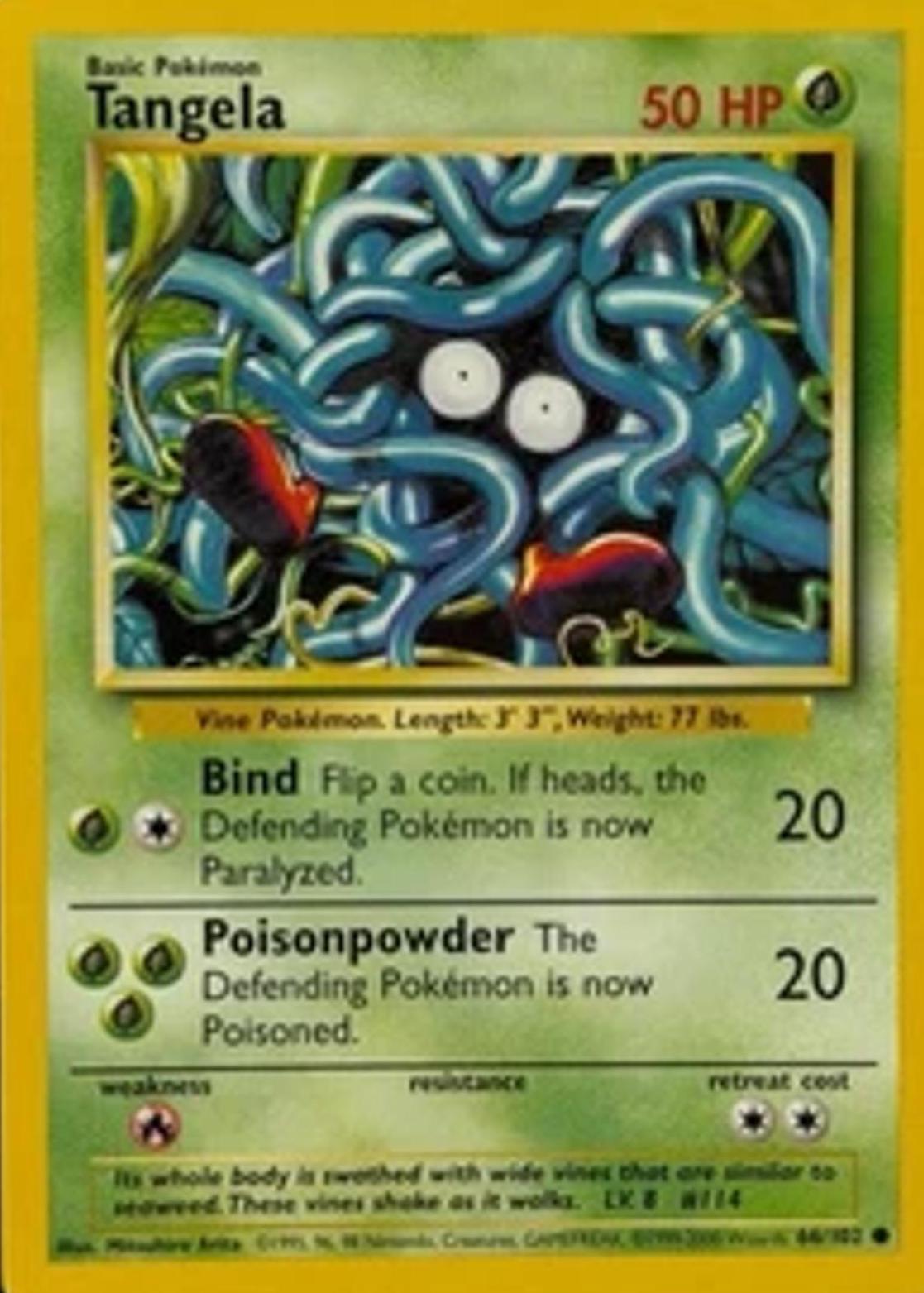
Tangela #66/102 is the Base Set Common hiding an unlikely secret: it was nearly called Medusa, and its tangle of blue vines grew from Greek myth. Arita's 1999 illustration froze that idea beside Charizard in the first print run. Printed for only the opening weeks of 1999, the 1st Edition is the scarce version: raw near-mint copies trade near $25, while a PSA 10 averages $428.
This page covers the 1st Edition printing specifically — the stamped, shadowless-stock version from the original January 1999 run. If you are unsure which of the Base Set Tangela printings you own, the 3-second test below settles it before you read any further.
| Grade | Market Price | Share of graded copies |
|---|---|---|
| Ungraded (raw) | $25 | — |
| PSA 7 (NM) | $40 | 8.3% |
| PSA 8 (NM-MT) | $58 | 20.2% |
| PSA 9 (Mint) | $89 | 36.3% |
| PSA 10 (Gem Mint) | $428 | 27.2% |
| Grade 6 or below | — | 7.9% |
Prices and population shares: the Cards Worth Chasing ranking, PSA only, September 2026. Shares are of all PSA-graded copies of this card, so they sum to 100% with the grade-6-and-below row. Grading cost basis $59.99 (PSA Standard). Comps move — verify current sold prices before transacting.
Live Now on eBay: 1st Edition Tangela
What the card is actually being offered for right now. Every listing below is filtered to the genuine 1st Edition card — no repacks, mystery slabs, card skins, or multi-card lots. These are asking prices, not sold comps, so treat them as the top of the market rather than what copies are changing hands for. Buying through these links supports the site at no extra cost to you.
Loading current listings…
Which One Do You Have? The 3-Second Test
Most people who say “I have a 1st Edition Tangela” don’t. Retail packs in 1999–2000 were overwhelmingly Unlimited printing — and that’s fine, it’s the same iconic card. The fast check, in order:
- Right edge of the art box: a dark drop shadow = Unlimited or 4th Print. No shadow = keep going.
- Left of the art box: a black “Edition 1” stamp = 1st Edition. No stamp + no shadow = Shadowless.
- Bottom copyright line: ©1999-2000 = 4th Print. The font weight is the tiebreaker — thin text means an early print.
Tangela is a Basic Grass with 50 HP, illustrated by Mitsuhiro Arita. On a raw copy, inspect the lower-left of the art window for a clean, solid black 'Edition 1' stamp — the thickness of its '1' tells you which stamp variety you have — then confirm the border is shadowless, with no drop shadow running down the right edge of the picture frame.
The four printings of Base Set each have their own price and history: 1st Edition · Shadowless · Unlimited · 4th Print.
Click to enlarge
 Click to enlarge
 Click to enlarge
 Click to enlarge
PSA 8 prices from PriceCharting sold-comp data, September 2026. Unlimited and 4th Print look nearly identical — the copyright year is the difference. Each printing is its own card with its own price and history; see every printing: 1st Edition · Shadowless · Unlimited · 4th Print.
About This Card and Set
Tangela has one of the strangest origin stories in the Base Set. In early English development the Pokémon was going to be called Meduza, a direct nod to the Greek gorgon Medusa, whose serpent hair the creature's tangle of blue vines echoes. Nintendo dropped the name before release, keeping Tangela — a play on 'tangle' — while the Japanese original, Monjara, comes from mojamoja, the word for shagginess. The design itself reads as seaweed, tumbleweed and a nest of vines wrapped so completely that only its eyes and red boots show. In print, the card arrived first in Japan's Expansion Pack and reached English collectors in the 1999 Base Set as card 66/102, a Common illustrated by Mitsuhiro Arita, the artist who had helped define the set's look from its earliest days.
Tangela's card was never a headline chase, but the Pokémon built real nostalgia elsewhere. It debuted in the anime episode 'Pokémon Scent-sation!', fighting for Celadon Gym Leader Erika and paralyzing Ash's Bulbasaur with Stun Spore before falling to his Charmander — a small, memorable role fans still recall. In the Pokémon Adventures manga, Erika's own Tangela is nicknamed Angela. On the card side, #66/102 was reprinted in Base Set 2 in 2000 as 96/130, carrying the same Arita art but a new set symbol and no 1st Edition or Shadowless run. For many collectors the 1st Edition holds a quiet appeal: a Common almost nobody preserved, sitting in the same first print run as Charizard.
How Rare Is This Card?
Start with the number that describes the whole card: roughly 2,496 graded copies exist in total, and ~679 of those are PSA 10s. That is a gem rate of about 27.2% — and the gem rate, not the raw population, is what a collector should actually be reading. High-grade supply is what the market pays for.
| Card | PSA 10s | Total graded | Gem rate |
|---|---|---|---|
| Tangela 1st Edition (1999) | ~679 | ~2,496 | ~27.2% |
| Charizard ex #199, S&V 151 (2023) | 29,679 | 102,490 | ~29% |
PriceCharting population data, September 2026. The modern row is a combined PSA + CGC count; the 1999 row is PSA, the way it is normally quoted.
Tangela has one of the deeper graded populations in this part of the set, and roughly a quarter of submitted copies reach PSA 10.
The card is a folklore piece first and a population piece second; the Blue Stain error that made it famous lives on Unlimited copies only, not here.For scale, a comparable modern chase card converts to a gem grade at roughly 29%. Modern cards grade far better than vintage ones — not because they are better cards, but because a 1999 card was printed before grading was mainstream and then spent two decades in a binder.
Source: the PSA-only figures behind the Cards Worth Chasing ranking, September 2026. Two caveats stay attached to every population figure on this site. Graded counts are submission tallies, not unique cards — resubmissions inflate the total. And the census is a floor, not a final number.
Known Error Cards
The one widely catalogued Tangela misprint belongs to the Unlimited printing, not the 1st Edition. Known as 'Blue Stain Tangela', it is a large cyan ink hickey printed across the artwork, consistent enough in shape to be a repeating defect; Bulbapedia calls it one of the largest repeating printer hickies in the set. Elite Fourum's Base Set misprint guide lists two variants, nicknamed 'Brain Aneurysm Tangela' and 'Bottom Hickey Tangela', both recorded for Unlimited. The 1st Edition printing itself carries no documented misprint in the Bulbapedia, PSA or PokeBeach error references. What it does have is stamp variety — thick and thin 'Edition 1' stamps, plus 2D, 3D and occasionally gray versions. Those are stamp differences, not errors. A 2016 PokeBeach thread surfaced a Tangela with a yellow mark near the Pokédex text, but no printing or official recognition was ever confirmed.
What Makes This Card Collectible?
Three reasons this quiet Common earns a place in a 1st Edition collection.
- First-print only. The 'Edition 1' stamp sat on this card for only the opening weeks of the 1999 release before Wizards moved to Shadowless and then Unlimited.
- Clean by default. The famous Blue Stain error exists only on Unlimited copies, so a defect-free 1st Edition is the tidier, more desirable version.
- Frozen artwork. Arita's vine-wrapped illustration was reused unchanged for Base Set 2, making #66/102 the original printing of that image.
For collectors, the 1st Edition is the print of Tangela #66/102 worth keeping.
The Artist: Mitsuhiro Arita
Mitsuhiro Arita is one of the illustrators who defined the look of the original English Pokémon TCG, and Tangela is one of their Base Set contributions. This section will carry their full numbers when the artist guide lands.
Caleb's Collector Verdict
Tangela #66/102 is a quiet 1st Edition Common with a genuine folklore origin and an error story that belongs to a different printing.
People Also Ask
Is my 1st Edition Tangela real or fake?
The 1999 Base Set cards are the most counterfeited in the hobby, and for a raw copy worth real money you cannot settle it from a photo. The checks that catch most fakes: the light test (a genuine card is essentially opaque — a faint dark core line between the layers; cheap fakes glow through), the stamp rule (a real 1st Edition stamp is crisp and sits under the ink, and counterfeiters add stamps to Unlimited cards — read it with the drop shadow and the 1995-99 copyright line, never alone), and the back (fakes perfect the front and neglect the Poké Ball, the blue tone and the repeated text). Above a few hundred dollars, a raw copy should get professional pre-authentication. The full fake-detection walkthrough covers all of it.
Should I grade this card?
Raw 1st Edition copies sit around $25, while a PSA 10 averages $428. The gem rate is roughly 27%: across PSA and SGC about 4,995 Tangela copies have been graded, with only 1,339 reaching PSA 10. Because that strike rate is decent and grading fees can eat into a $25 card, submitting only makes sense if your copy has genuinely sharp corners and clean centering — otherwise the raw card is the better call.