
Starmie 1st Edition Base Set: Misty's Gem of the Sea
Reviewed by Caleb Stapel · Collector · Updated September 2026
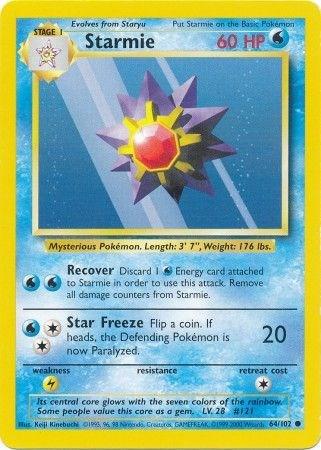
Starmie 64/102 never headlined a set, but it carries more early-Pokémon history than most Uncommons. Prototype League leaders handed it out in the red-bordered Trainer Deck B before Base Set ever reached shelves, and Misty's Starmie debuted in the seventh anime episode. Keiji Kinebuchi's 3D render also pioneered a look that aged into nostalgia. Raw near-mint copies trade around $38, while a PSA 10 example has sold for $781.
This page covers the 1st Edition printing specifically — the stamped, shadowless-stock version from the original January 1999 run. If you are unsure which of the Base Set Starmie printings you own, the 3-second test below settles it before you read any further.
| Grade | Market Price | Share of graded copies |
|---|---|---|
| Ungraded (raw) | $38 | — |
| PSA 7 (NM) | $60 | 7.2% |
| PSA 8 (NM-MT) | $91 | 17.7% |
| PSA 9 (Mint) | $140 | 41.5% |
| PSA 10 (Gem Mint) | $781 | 25.6% |
| Grade 6 or below | — | 7.9% |
Prices and population shares: the Cards Worth Chasing ranking, PSA only, September 2026. Shares are of all PSA-graded copies of this card, so they sum to 100% with the grade-6-and-below row. Grading cost basis $59.99 (PSA Standard). Comps move — verify current sold prices before transacting.
Live Now on eBay: 1st Edition Starmie
What the card is actually being offered for right now. Every listing below is filtered to the genuine 1st Edition card — no repacks, mystery slabs, card skins, or multi-card lots. These are asking prices, not sold comps, so treat them as the top of the market rather than what copies are changing hands for. Buying through these links supports the site at no extra cost to you.
Loading current listings…
Which One Do You Have? The 3-Second Test
Most people who say “I have a 1st Edition Starmie” don’t. Retail packs in 1999–2000 were overwhelmingly Unlimited printing — and that’s fine, it’s the same iconic card. The fast check, in order:
- Right edge of the art box: a dark drop shadow = Unlimited or 4th Print. No shadow = keep going.
- Left of the art box: a black “Edition 1” stamp = 1st Edition. No stamp + no shadow = Shadowless.
- Bottom copyright line: ©1999-2000 = 4th Print. The font weight is the tiebreaker — thin text means an early print.
Starmie is a Stage 1 Water with 60 HP, illustrated by Keiji Kinebuchi. In a raw 1st Edition copy, confirm the Edition 1 stamp sits just left of the artwork with the middle of the “T” in EDITION lining up to the art box’s bottom-left corner, and that the non-holo stamp is the normal thick variant rather than a gray or smeared transfer.
The four printings of Base Set each have their own price and history: 1st Edition · Shadowless · Unlimited · 4th Print.
Click to enlarge
 Click to enlarge
 Click to enlarge
 Click to enlarge
PSA 8 prices from PriceCharting sold-comp data, September 2026. Unlimited and 4th Print look nearly identical — the copyright year is the difference. Each printing is its own card with its own price and history; see every printing: 1st Edition · Shadowless · Unlimited · 4th Print.
About This Card and Set
Starmie reached American players twice before the Base Set officially launched. Prototype Pokémon League leaders were handed the red-bordered Trainer Deck B — Misty’s Deck — with three Starmie inside, and the card appeared in the Japanese Expansion Pack before arriving as 64/102 in the 1999 English Base Set. It sat in the Uncommon slot of a 102-card set, between Dugtrio and Staryu, through Wizards of the Coast’s earliest print runs. Every 1st Edition copy is shadowless, stamped with the Edition 1 mark, and printed only during the first weeks of the 1999 release. Base Set 2 reused the same Kinebuchi art as 94/130 in 2000, and Evolutions revisited it in 2016 as 31/108 — a Rare with 90 HP, a new Space Beacon Ability and a different Pokédex entry, which makes the 1st Edition the original and the outlier.
Starmie is a starfish — most likely the sunflower sea star, with its many arms and violet body — wrapped around a core the games call “the gem of the sea.” Its Japanese name, Sutāmī, and the English reading of “star, you” and “star, me” pair it with Staryu, while fans have long noted the jewel resembles the Colour Timer on Ultraman’s chest, blinking when the hero runs low. In-universe folklore gives it two origins at once: a creature that fires radio waves into space, and in ancient imagining a thing formed from starlight reflected on night water. Misty’s Starmie debuted in episode seven, “The Water Flowers of Cerulean City,” in 1998.
How Rare Is This Card?
Start with the number that describes the whole card: roughly 1,490 graded copies exist in total, and ~382 of those are PSA 10s. That is a gem rate of about 25.6% — and the gem rate, not the raw population, is what a collector should actually be reading. High-grade supply is what the market pays for.
| Card | PSA 10s | Total graded | Gem rate |
|---|---|---|---|
| Starmie 1st Edition (1999) | ~382 | ~1,490 | ~25.6% |
| Charizard ex #199, S&V 151 (2023) | 29,679 | 102,490 | ~29% |
PriceCharting population data, September 2026. The modern row is a combined PSA + CGC count; the 1999 row is PSA, the way it is normally quoted.
Starmie carries a mid-sized graded population and a gem rate in the ordinary range for a Base Set Uncommon.
None of that is the point of the card — its interest is the Trainer Deck B pedigree and the Kinebuchi render, with the PSA 10 acting mainly as a condition premium.For scale, a comparable modern chase card converts to a gem grade at roughly 29%. Modern cards grade far better than vintage ones — not because they are better cards, but because a 1999 card was printed before grading was mainstream and then spent two decades in a binder.
Source: the PSA-only figures behind the Cards Worth Chasing ranking, September 2026. Two caveats stay attached to every population figure on this site. Graded counts are submission tallies, not unique cards — resubmissions inflate the total. And the census is a floor, not a final number.
Known Error Cards
Base Set Starmie 64/102 has no documented repeating error. Bulbapedia’s Error cards page, PSA’s Pokémon Error Guide, PokeBeach’s misprint database and Elite Fourum’s English Base Set Master Misprint Guide all pass the card over; the Base Set entries that do exist belong to other cards and other printings. The nearest name is its own evolution, Staryu 65/102, which carries the magenta “Red Hickey” on Unlimited copies only. The Starmie that does hold a Bulbapedia error is a later card in a different set, where the evolution box reuses older Sugimori Red and Blue stock art — that fault does not belong to this page.
What genuinely applies here are set-wide 1st Edition stamp variants rather than card-specific faults: gray stamps, white stamps, back-stamp ink transfers and front stamp smears all occur on 1st Edition commons and uncommons, and Starmie’s Uncommon slot falls inside that group.
What Makes This Card Collectible?
Starmie 1st Edition is an Uncommon that behaves like a chase card, and almost every reason is historical rather than visual.
- Trainer Deck B. Three Starmie were packed into Misty's red-bordered prototype deck, printed and distributed before the Base Set's public launch.
- A naming pair. It completes the Staryu and Starmie “you and me” set, so anyone chasing one 1st Edition card usually ends up buying both.
- Shadowless only. Every 1st Edition copy predates the drop shadow, so the printing itself is fixed and the stamp is the single thing to verify.
It is a quiet card that rewards the collector who reads print runs instead of attack text.
The Artist: Keiji Kinebuchi
Keiji Kinebuchi is one of the illustrators who defined the look of the original English Pokémon TCG, and Starmie is one of their Base Set contributions. This section will carry their full numbers when the artist guide lands.
Caleb's Collector Verdict
Starmie 64/102 is the most honest way into 1st Edition Base Set without pretending you are buying a Charizard.
People Also Ask
Is my 1st Edition Starmie real or fake?
The 1999 Base Set cards are the most counterfeited in the hobby, and for a raw copy worth real money you cannot settle it from a photo. The checks that catch most fakes: the light test (a genuine card is essentially opaque — a faint dark core line between the layers; cheap fakes glow through), the stamp rule (a real 1st Edition stamp is crisp and sits under the ink, and counterfeiters add stamps to Unlimited cards — read it with the drop shadow and the 1995-99 copyright line, never alone), and the back (fakes perfect the front and neglect the Poké Ball, the blue tone and the repeated text). Above a few hundred dollars, a raw copy should get professional pre-authentication. The full fake-detection walkthrough covers all of it.
Should I grade this card?
Raw near-mint copies sit around $38 against a $781 PSA 10, so the spread is real — but only roughly one in four submitted copies comes back a gem. Submitting makes sense for a sharp, well-centred copy, or to authenticate a 1st Edition stamp you doubt; on an average copy the fee eats the upside.