
Rattata 1st Edition Base Set: The $29 Common With a Secret
Reviewed by Caleb Stapel · Collector · Updated September 2026
Rattata looks like filler, but Base Set's most unassuming common carries genuine prototype history: it shipped four copies deep in Trainer Deck A, the Brock-themed demo deck handed to prototype Pokémon Leagues weeks before the game launched. The same art also exists in first-print Shadowless state, where a stray magenta ink flaw earned it the nickname “Red Dot Rattata.” Raw Near Mint copies trade around $29, while a PSA 10 climbs to roughly $472.
This page covers the 1st Edition printing specifically — the stamped, shadowless-stock version from the original January 1999 run. If you are unsure which of the Base Set Rattata printings you own, the 3-second test below settles it before you read any further.
| Grade | Market Price | Share of graded copies |
|---|---|---|
| Ungraded (raw) | $29 | — |
| PSA 7 (NM) | $38 | 8.7% |
| PSA 8 (NM-MT) | $45 | 19.4% |
| PSA 9 (Mint) | $86 | 38.7% |
| PSA 10 (Gem Mint) | $472 | 26.2% |
| Grade 6 or below | — | 6.9% |
Prices and population shares: the Cards Worth Chasing ranking, PSA only, September 2026. Shares are of all PSA-graded copies of this card, so they sum to 100% with the grade-6-and-below row. Grading cost basis $59.99 (PSA Standard). Comps move — verify current sold prices before transacting.
Live Now on eBay: 1st Edition Rattata
What the card is actually being offered for right now. Every listing below is filtered to the genuine 1st Edition card — no repacks, mystery slabs, card skins, or multi-card lots. These are asking prices, not sold comps, so treat them as the top of the market rather than what copies are changing hands for. Buying through these links supports the site at no extra cost to you.
Loading current listings…
Which One Do You Have? The 3-Second Test
Most people who say “I have a 1st Edition Rattata” don’t. Retail packs in 1999–2000 were overwhelmingly Unlimited printing — and that’s fine, it’s the same iconic card. The fast check, in order:
- Right edge of the art box: a dark drop shadow = Unlimited or 4th Print. No shadow = keep going.
- Left of the art box: a black “Edition 1” stamp = 1st Edition. No stamp + no shadow = Shadowless.
- Bottom copyright line: ©1999-2000 = 4th Print. The font weight is the tiebreaker — thin text means an early print.
Rattata is a Basic Colorless with 30 HP, illustrated by Mitsuhiro Arita. On a raw copy, confirm the black ‘Edition 1’ stamp sits cleanly inside its circle below the artwork and check whether it is the lighter gray-stamp variant, then inspect the corners and edges, since first-print stock shows white chipping readily.
The four printings of Base Set each have their own price and history: 1st Edition · Shadowless · Unlimited · 4th Print.
Click to enlarge
 Click to enlarge
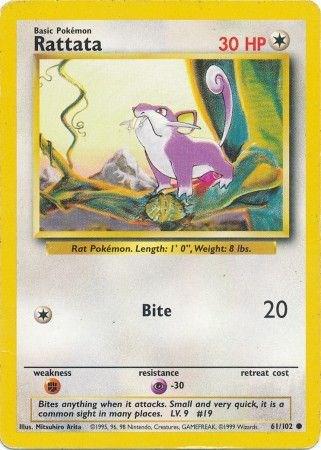 Click to enlarge
 Click to enlarge
PSA 8 prices from PriceCharting sold-comp data, September 2026. Unlimited and 4th Print look nearly identical — the copyright year is the difference. Each printing is its own card with its own price and history; see every printing: 1st Edition · Shadowless · Unlimited · 4th Print.
About This Card and Set
Rattata is card 61/102, a Colorless Basic and one of the original 102 cards in the English Base Set released by Wizards of the Coast on January 9, 1999. Before retail launch, prototype Pokémon Leagues received Trainer Deck A — “Brock's Deck” — a non-commercial demo product whose cards carried a red border and the deck name printed on the back. Rattata appeared four times in that deck, tying this humble common to the TCG's pre-release testing phase rather than to any competitive use.
The card's nickname comes from a printing flaw: on first-print Shadowless sheets, two small magenta dots appeared above the set-symbol area, and collectors know the result as “Red Dot Rattata.” The species carries its own fame. Rattata debuted in the anime's opening episode, “Pokémon, I Choose You!,” rummaging through Ash's backpack, and it later became a running joke through Youngster Joey's boast that his was in the “top percentage of Rattata.” Its design is a straight read on the rat — large ears recalling a dumbo rat, a name built from “rat” and “attack.”
Base Set also had no set symbol, and the 1999 first printing ran on the Shadowless template, with no drop shadow behind the art box. A separate “Gray Stamp” variant, carrying a lighter, less-saturated Edition 1 stamp, marks the very earliest English print run and is treated as its own collectible.
How Rare Is This Card?
Start with the number that describes the whole card: roughly 2,376 graded copies exist in total, and ~623 of those are PSA 10s. That is a gem rate of about 26.2% — and the gem rate, not the raw population, is what a collector should actually be reading. High-grade supply is what the market pays for.
| Card | PSA 10s | Total graded | Gem rate |
|---|---|---|---|
| Rattata 1st Edition (1999) | ~623 | ~2,376 | ~26.2% |
| Charizard ex #199, S&V 151 (2023) | 29,679 | 102,490 | ~29% |
PriceCharting population data, September 2026. The modern row is a combined PSA + CGC count; the 1999 row is PSA, the way it is normally quoted.
Rattata's population is large and its gem rate sits near a quarter, so a high grade is achievable without being automatic.
The card's value rests on first-print history rather than on the census: Trainer Deck A ties and gray-stamp variants move the needle more than the PSA 10 does.For scale, a comparable modern chase card converts to a gem grade at roughly 29%. Modern cards grade far better than vintage ones — not because they are better cards, but because a 1999 card was printed before grading was mainstream and then spent two decades in a binder.
Source: the PSA-only figures behind the Cards Worth Chasing ranking, September 2026. Two caveats stay attached to every population figure on this site. Graded counts are submission tallies, not unique cards — resubmissions inflate the total. And the census is a floor, not a final number.
Known Error Cards
Base Set's best-known Rattata flaw is the magenta-dot error, documented on Shadowless copies: two small dots of extra magenta ink sit above the set-symbol area, closely matching in size and placement across affected cards. Elite Fourum's master misprint guide lists it as “Red Dot Rattata — Additional Magenta Ink — Shadowless,” and Bulbapedia records the same detail. PSA's error guide covers Base Set dot errors but does not list Rattata, and PokeBeach's error database omits it; the Elite Fourum list of errors exclusive to Unlimited also excludes it. No error is documented as unique to the 1st Edition printing, so a stamped copy should be judged on stamp clarity and condition rather than a named flaw.
What Makes This Card Collectible?
Rattata 1st Edition rewards the collector who cares about first-print history rather than headline rarity.
- Prototype ties. Four copies of this card were packed into Trainer Deck A, the red-bordered Brock demo deck handed to early Pokémon Leagues before launch.
- Gray stamp. The earliest English 1st Edition run produced a lighter, less-saturated Edition 1 stamp that collectors track as a separate variant.
- Grade gap. With only roughly a quarter of submitted copies earning PSA 10, a gem is achievable but never guaranteed, so buy the example rather than the grade.
For a card that anchored the game's very first booster packs, that blend of story and accessibility is hard to beat.
The Artist: Mitsuhiro Arita
Mitsuhiro Arita is one of the illustrators who defined the look of the original English Pokémon TCG, and Rattata is one of their Base Set contributions. This section will carry their full numbers when the artist guide lands.
Caleb's Collector Verdict
A first-print common with real prototype provenance, Rattata is the quiet Base Set card that outlasts flashier buys.
People Also Ask
Is my 1st Edition Rattata real or fake?
The 1999 Base Set cards are the most counterfeited in the hobby, and for a raw copy worth real money you cannot settle it from a photo. The checks that catch most fakes: the light test (a genuine card is essentially opaque — a faint dark core line between the layers; cheap fakes glow through), the stamp rule (a real 1st Edition stamp is crisp and sits under the ink, and counterfeiters add stamps to Unlimited cards — read it with the drop shadow and the 1995-99 copyright line, never alone), and the back (fakes perfect the front and neglect the Poké Ball, the blue tone and the repeated text). Above a few hundred dollars, a raw copy should get professional pre-authentication. The full fake-detection walkthrough covers all of it.
Should I grade this card?
Raw Near Mint copies run about $29, while a PSA 10 sells near $472, and grading data suggests roughly a quarter of submitted copies earn the top grade. Because the raw cost is low, submitting only makes sense on a genuinely clean, well-centered copy — on a chipped or off-center example, grading fees and shipping can consume most of the upside, and it is better kept raw.