
Poliwag 1st Edition Base Set: Tajiri's Favorite
Reviewed by Caleb Stapel · Collector · Updated September 2026
Poliwag is the one Base Set card bound directly to the franchise's origin: it is Satoshi Tajiri's reported favorite Pokémon, built from his childhood memory of picking up a tadpole and seeing its coiled intestines through translucent skin. That spiral became the whole family's motif. Card 59/102 is the ordinary Common through which the founding idea reached cardboard. Raw Near Mint copies trade around $23, while a PSA 10 sells near $559.
This page covers the 1st Edition printing specifically — the stamped, shadowless-stock version from the original January 1999 run. If you are unsure which of the Base Set Poliwag printings you own, the 3-second test below settles it before you read any further.
| Grade | Market Price | Share of graded copies |
|---|---|---|
| Ungraded (raw) | $23 | — |
| PSA 7 (NM) | $28 | 7.9% |
| PSA 8 (NM-MT) | $54 | 18.3% |
| PSA 9 (Mint) | $103 | 35.5% |
| PSA 10 (Gem Mint) | $559 | 30.1% |
| Grade 6 or below | — | 8.1% |
Prices and population shares: the Cards Worth Chasing ranking, PSA only, September 2026. Shares are of all PSA-graded copies of this card, so they sum to 100% with the grade-6-and-below row. Grading cost basis $59.99 (PSA Standard). Comps move — verify current sold prices before transacting.
Live Now on eBay: 1st Edition Poliwag
What the card is actually being offered for right now. Every listing below is filtered to the genuine 1st Edition card — no repacks, mystery slabs, card skins, or multi-card lots. These are asking prices, not sold comps, so treat them as the top of the market rather than what copies are changing hands for. Buying through these links supports the site at no extra cost to you.
Loading current listings…
Which One Do You Have? The 3-Second Test
Most people who say “I have a 1st Edition Poliwag” don’t. Retail packs in 1999–2000 were overwhelmingly Unlimited printing — and that’s fine, it’s the same iconic card. The fast check, in order:
- Right edge of the art box: a dark drop shadow = Unlimited or 4th Print. No shadow = keep going.
- Left of the art box: a black “Edition 1” stamp = 1st Edition. No stamp + no shadow = Shadowless.
- Bottom copyright line: ©1999-2000 = 4th Print. The font weight is the tiebreaker — thin text means an early print.
Poliwag is a Basic Water with 40 HP, illustrated by Ken Sugimori. On a raw copy, confirm the black “Edition 1” stamp sits just left of the artwork and that the art box carries no drop shadow — a true 1st Edition uses the shadowless template, with an extra ’99 in the copyright line.
The four printings of Base Set each have their own price and history: 1st Edition · Shadowless · Unlimited · 4th Print.
Click to enlarge
 Click to enlarge
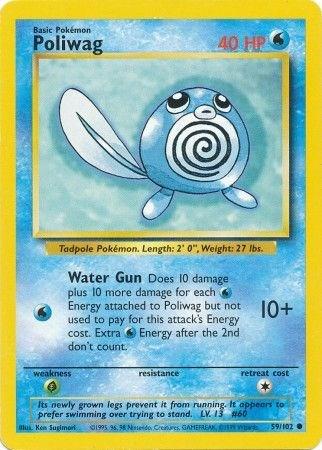 Click to enlarge
 Click to enlarge
PSA 8 prices from PriceCharting sold-comp data, September 2026. Unlimited and 4th Print look nearly identical — the copyright year is the difference. Each printing is its own card with its own price and history; see every printing: 1st Edition · Shadowless · Unlimited · 4th Print.
About This Card and Set
Poliwag exists because Satoshi Tajiri once held a tadpole. The Pokémon co-creator has said his childhood fascination with the frogs and insects around his rural hometown shaped Pokémon itself, and Poliwag is the purest expression of it: the swirl on its belly is the tadpole’s coiled intestine, visible through translucent skin, exactly as Tajiri remembered seeing it. He has described picking a pollywog up and being able to see its guts, and the design turns that small, faintly unsettling observation into a cute spiral. Its Japanese name, Nyoromo, comes from nyoro-nyoro — a squirming, wriggling motion. The English name fuses “polliwog” and “wag.” Tajiri is widely reported to count Poliwag among his favorites, and the line is built on the tadpole’s real metamorphosis into a frog, which Pokémon evolution quietly mirrors.
Base Set Poliwag is card 59/102, a Common, illustrated by Ken Sugimori — the artist behind the original artwork for all 151 Generation I Pokémon and Tajiri’s early design partner. Its Pokédex text is adapted from Red and Blue, so the card reads as a snapshot of 1998 Kanto. The English set arrived on January 9, 1999. Sugimori’s art returned unchanged in Base Set 2 (88/130, February 2000); the 2016 Evolutions reprint redrew the card entirely and raised its HP to 60, and a near-unobtainable Japanese print from the CoroCoro Pokémon Snap Best Photo Contest photographed the creature instead. In the anime, Misty caught a Poliwag in “The Stun Spore Detour,” and it later evolved into Poliwhirl, then Politoed.
How Rare Is This Card?
Start with the number that describes the whole card: roughly 2,694 graded copies exist in total, and ~812 of those are PSA 10s. That is a gem rate of about 30.1% — and the gem rate, not the raw population, is what a collector should actually be reading. High-grade supply is what the market pays for.
| Card | PSA 10s | Total graded | Gem rate |
|---|---|---|---|
| Poliwag 1st Edition (1999) | ~812 | ~2,694 | ~30.1% |
| Charizard ex #199, S&V 151 (2023) | 29,679 | 102,490 | ~29% |
PriceCharting population data, September 2026. The modern row is a combined PSA + CGC count; the 1999 row is PSA, the way it is normally quoted.
Poliwag sits in the middle of the Base Set commons by population: a healthy graded total with a gem rate near thirty percent, which is generous for a 1999 card.
As a founding-Pokemon common it is collected for story and set-completion rather than scarcity, so raw supply stays easy and the money concentrates at the very top of the grade scale.For scale, a comparable modern chase card converts to a gem grade at roughly 29%. Modern cards grade far better than vintage ones — not because they are better cards, but because a 1999 card was printed before grading was mainstream and then spent two decades in a binder.
Source: the PSA-only figures behind the Cards Worth Chasing ranking, September 2026. Two caveats stay attached to every population figure on this site. Graded counts are submission tallies, not unique cards — resubmissions inflate the total. And the census is a floor, not a final number.
Known Error Cards
None of the four major references documents a text or design error on Poliwag 59/102. Bulbapedia’s Error cards page, the PSA Pokémon Error Guide, PokeBeach’s misprint database, and Elite Fourum’s Base Set misprint guide and Unlimited-only thread all omit it. Base Set’s known errors sit on other cards — Vulpix’s “HP 50,” Caterpie and Metapod’s reversed HP, Wartortle’s evolution box, Blastoise’s missing “Stage,” Ninetales’ missing damage, Diglett’s sideways Fighting symbol — and virtually all of those belong to the Unlimited or Shadowless printings, not 1st Edition. The one legitimate production anomaly found on a 1st Edition Poliwag is the “grey stamp”: because the Edition-1 mark was applied in a separate pass, some commons carry it faint or grey. That is a printing characteristic, not a card error, and it is genuinely rarer.
What Makes This Card Collectible?
Poliwag 59/102 is a low-dollar card carrying an outsized story — the Pokémon that arguably started it all.
- Founding-Pokémon pedigree. This is the card of Satoshi Tajiri’s favorite creature, designed from his own tadpole memory, which gives an otherwise ordinary Common a real place in franchise history.
- Stamp variants. Because 1st Edition stamps were applied separately, gray stamps, off-aligned 3D stamps and faint mirror-imprints on nearby cards turn a cheap common into a huntable sub-collection.
- Deep nostalgia. Misty’s anime Poliwag, the Red and Blue Pokédex text and Sugimori’s Gen I art all converge on the same little blue card that 1999 kids pulled from packs.
Buy it for the story and the print-quality hunt, not for a flip.
The Artist: Ken Sugimori
Ken Sugimori is one of the illustrators who defined the look of the original English Pokémon TCG, and Poliwag is one of their Base Set contributions. This section will carry their full numbers when the artist guide lands.
Caleb's Collector Verdict
A charming, story-rich common that is easy to own raw but genuinely hard to own as a clean, well-centered gem.
People Also Ask
Is my 1st Edition Poliwag real or fake?
The 1999 Base Set cards are the most counterfeited in the hobby, and for a raw copy worth real money you cannot settle it from a photo. The checks that catch most fakes: the light test (a genuine card is essentially opaque — a faint dark core line between the layers; cheap fakes glow through), the stamp rule (a real 1st Edition stamp is crisp and sits under the ink, and counterfeiters add stamps to Unlimited cards — read it with the drop shadow and the 1995-99 copyright line, never alone), and the back (fakes perfect the front and neglect the Poké Ball, the blue tone and the repeated text). Above a few hundred dollars, a raw copy should get professional pre-authentication. The full fake-detection walkthrough covers all of it.
Should I grade this card?
Raw Near Mint 1st Edition copies run about $23, and PSA grades roughly 29% of submitted examples a 10 — a healthy gem rate. But with PSA’s regular tier costing around $80 a card, the margin only works if you already hold a genuinely sharp copy: strong centering, clean surface, crisp corners. For a played or off-center example it is almost never worth the fee, so grade only the best raw copy you own.