
Pokémon Trader 1st Edition Base Set: The First Trade
Reviewed by Caleb Stapel · Collector · Updated September 2026
Pokémon Trader fixes a bad hand and pays for it in information: you swap a Pokémon card from hand for one from your deck, and you have to show your opponent both. It is the hobby’s defining act turned into a rule. Raw copies sit near $49, with a 14.3% Gem Mint rate.
This page covers the 1st Edition printing specifically — the stamped, shadowless-stock version from the original January 1999 run. If you are unsure which of the Base Set Pokémon Trader printings you own, the 3-second test below settles it before you read any further.
| Grade | Market Price | Share of graded copies |
|---|---|---|
| Ungraded (raw) | $49 | — |
| PSA 7 (NM) | $60 | 8.7% |
| PSA 8 (NM-MT) | $62 | 21.3% |
| PSA 9 (Mint) | $255 | 45.9% |
| PSA 10 (Gem Mint) | $1,127 | 14.3% |
| Grade 6 or below | — | 9.8% |
Prices and population shares: the Cards Worth Chasing ranking, PSA only, September 2026. Shares are of all PSA-graded copies of this card, so they sum to 100% with the grade-6-and-below row. Grading cost basis $59.99 (PSA Standard). Comps move — verify current sold prices before transacting.
Live Now on eBay: 1st Edition Pokémon Trader
What the card is actually being offered for right now. Every listing below is filtered to the genuine 1st Edition card — no repacks, mystery slabs, card skins, or multi-card lots. These are asking prices, not sold comps, so treat them as the top of the market rather than what copies are changing hands for. Buying through these links supports the site at no extra cost to you.
Loading current listings…
Which One Do You Have? The 3-Second Test
Most people who say “I have a 1st Edition Pokémon Trader” don’t. Retail packs in 1999–2000 were overwhelmingly Unlimited printing — and that’s fine, it’s the same iconic card. The fast check, in order:
- Right edge of the art box: a dark drop shadow = Unlimited or 4th Print. No shadow = keep going.
- Left of the art box: a black “Edition 1” stamp = 1st Edition. No stamp + no shadow = Shadowless.
- Bottom copyright line: ©1999-2000 = 4th Print. The font weight is the tiebreaker — thin HP text means an early print.
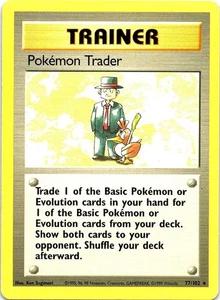
Pokémon Trader is a Trainer card illustrated by Ken Sugimori. Check edges for shuffle wear; this card was played in quantity.
The four printings of Base Set each have their own price and history: 1st Edition · Shadowless · Unlimited · 4th Print.
Click to enlarge
 Click to enlarge
 Click to enlarge
 Click to enlarge
PSA 8 prices from PriceCharting sold-comp data, September 2026. Unlimited and 4th Print look nearly identical — the copyright year is the difference. Each printing is its own card with its own price and history; see every printing: 1st Edition · Shadowless · Unlimited · 4th Print.
About This Card and Set
Pokémon Trader is card 77/102 in the English Base Set — a Rare Trainer first released on 9 January 1999. The 1st Edition is that debut printing, carrying the black “Edition 1” stamp beside the artwork on shadowless stock. It is a Trainer, not a Pokémon, and its identity rests on one idea: a player swaps a Pokémon card from hand for another from the deck, shows both to an opponent, then shuffles.
That rule gave the card its real-world character. The product was a Trading Card Game, and 1999 collecting was, for most children, the literal swapping of cards; a Trainer whose only job is to exchange one card for another is the hobby’s defining act reduced to a rule. Its Japanese title translates closer to “Pokémon Exchange Man,” and the Sugimori illustration shows one of the in-game characters who trades a Pokémon to the player.
The requirement to show both cards is the design compromise that matters. Later cards with a near-identical search effect, notably Pokémon Communication, drop it — and in two Game Boy Pokémon TCG titles the digital Trader could return the same card to hand, a glitch contradicting the printed text. Japan handled the card differently again: when Supporter cards arrived, every Japanese printing was errata’d to be played as a Supporter.
Print history runs deep for a rare Trainer. Prototype league decks called Trainer Deck B — red-bordered, with the deck’s name on the back — carried this card before Base Set reached the public, and it was reprinted in Base Set 2 (106/130) and Legendary Collection with the effect intact and the name unchanged.
How Rare Is This Card?
Read this card by its grade split rather than by a headline population. 14.3% of PSA-graded copies reach PSA 10, 9.8% come back grade 6 or below, and the rest land in between — which is what set the price ladder above.
Pokémon Trader sits at a 14.3% Gem Mint rate on a $49 raw.
| Card | PSA 10s | Total graded | Gem rate |
|---|---|---|---|
| 1st Edition Pokémon Trader (1999) | ~168 | ~1,174 | 14.3% |
| Charizard ex #199, S&V 151 (2023) | 29,679 | 102,490 | ~29% |
PriceCharting population data, September 2026. The modern row is a combined PSA + CGC count; the 1999 row is PSA, the way it is normally quoted.
For scale, a comparable modern chase card converts to a gem grade at roughly 29%. Modern cards grade far better than vintage ones — not because they are better cards, but because a 1999 card was printed before grading was mainstream and then spent two decades in a binder.
Source: the PSA-only figures behind the Cards Worth Chasing ranking, September 2026. Two caveats stay attached to every population figure on this site. Graded counts are submission tallies, not unique cards — resubmissions inflate the total. And the census is a floor, not a final number.
Known Error Cards
No error specific to Pokémon Trader is catalogued for the 1st Edition printing, or for any other printing of the card. The four standard references agree. Bulbapedia’s “Error cards” page lists no Trader entry under Base Set; PSA’s Pokémon Error Guide catalogues Beedrill, Blastoise, Diglett and Wartortle for Base Set and Ninetales and Pikachu for Shadowless, but nothing at 77/102; PokéBeach’s misprint database records Vulpix, Blastoise, Ninetales, Kakuna, Bulbasaur and the Prerelease Raichu, and no Trader; and Elite Fourum’s Base Set master misprint guide, which works card by card through the set, omits it.
The only 1st Edition anomalies touching this card are set-wide rather than card-specific: the familiar stamp variations — grey, smeared, bold or ghosted “Edition 1” impressions, and faint stamp transfers on the reverse — documented across the 1st Edition run generally.
What Makes This Card Collectible?
Pokémon Trader is collected for the idea, not the artwork:
- A rules text the game later dropped. The requirement to reveal both cards was the compromise later search effects abandoned — a small record of how cautious the first design was.
- An information cost printed on the card. Both the given and the taken card are shown to the opponent, which is what separates it from later search effects.
Its closest relative is the Computer Search review; the Base Set hub covers the Trainer half.
The Artist: Ken Sugimori
Ken Sugimori is one of the illustrators who defined the look of the original English Pokémon TCG, and Pokémon Trader is one of their Base Set contributions. This section will carry their full numbers when the artist guide lands.
Caleb's Collector Verdict
Pokémon Trader is the set’s honest search card: it fixes a bad hand, but it makes you show the fix to your opponent first. That visible cost is the detail the game quietly dropped from every search effect that followed.
People Also Ask
Is my 1st Edition Pokémon Trader real or fake?
The 1999 Base Set cards are the most counterfeited in the hobby, and for a raw copy worth real money you cannot settle it from a photo. The checks that catch most fakes: the light test, the stamp rule (read together with the drop shadow and the 1995-99 copyright line, never alone), and the back. Above a few hundred dollars, a raw copy should get professional pre-authentication. The full fake-detection walkthrough covers all of it.
Should I grade this card?
Decent odds at 14.3% on a $49 raw — a reasonable submission on a clean copy. See Should You Grade Pokémon Cards? for the fee maths, and check a raw copy with the CardGrader scanner before sending it in.