
Pokémon Center 1st Edition Base Set: The Healing Landmark
Reviewed by Caleb Stapel · Collector · Updated September 2026
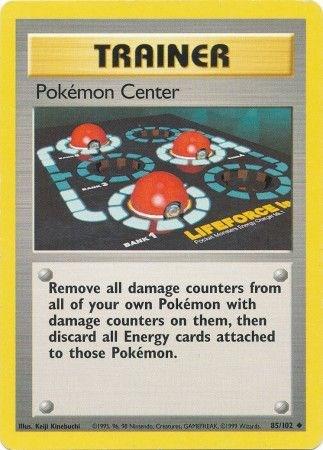
Most Base Set Trainers are pure utility, but this one has three lives: Keiji Kinebuchi's 1999 healing station, a Base Set 2 reprint, and a 2001 promo reworked into a CG render of the Pokémon Center New York's second floor. It is also among the few English cards that ever printed Pocket Monsters on its face. Raw near-mint copies trade around $11, while a PSA 10 sits near $430.
This page covers the 1st Edition printing specifically — the stamped, shadowless-stock version from the original January 1999 run. If you are unsure which of the Base Set Pokémon Center printings you own, the 3-second test below settles it before you read any further.
| Grade | Market Price | Share of graded copies |
|---|---|---|
| Ungraded (raw) | $11 | — |
| PSA 7 (NM) | $18 | 7.7% |
| PSA 8 (NM-MT) | $38 | 21.2% |
| PSA 9 (Mint) | $78 | 44.0% |
| PSA 10 (Gem Mint) | $430 | 21.3% |
| Grade 6 or below | — | 5.7% |
Prices and population shares: the Cards Worth Chasing ranking, PSA only, September 2026. Shares are of all PSA-graded copies of this card, so they sum to 100% with the grade-6-and-below row. Grading cost basis $59.99 (PSA Standard). Comps move — verify current sold prices before transacting.
Live Now on eBay: 1st Edition Pokémon Center
What the card is actually being offered for right now. Every listing below is filtered to the genuine 1st Edition card — no repacks, mystery slabs, card skins, or multi-card lots. These are asking prices, not sold comps, so treat them as the top of the market rather than what copies are changing hands for. Buying through these links supports the site at no extra cost to you.
Loading current listings…
Which One Do You Have? The 3-Second Test
Most people who say “I have a 1st Edition Pokémon Center” don’t. Retail packs in 1999–2000 were overwhelmingly Unlimited printing — and that’s fine, it’s the same iconic card. The fast check, in order:
- Right edge of the art box: a dark drop shadow = Unlimited or 4th Print. No shadow = keep going.
- Left of the art box: a black “Edition 1” stamp = 1st Edition. No stamp + no shadow = Shadowless.
- Bottom copyright line: ©1999-2000 = 4th Print. The font weight is the tiebreaker — thin text means an early print.
Pokémon Center is an Trainer, illustrated by Keiji Kinebuchi. In a raw copy, confirm the black Edition 1 stamp sits inside the lower-left of the artwork frame and that the art box carries no drop shadow, then tilt the card to catch any faint inverted stamp transfer on the back.
The four printings of Base Set each have their own price and history: 1st Edition · Shadowless · Unlimited · 4th Print.
Click to enlarge
 Click to enlarge
 Click to enlarge
 Click to enlarge
PSA 8 prices from PriceCharting sold-comp data, September 2026. Unlimited and 4th Print look nearly identical — the copyright year is the difference. Each printing is its own card with its own price and history; see every printing: 1st Edition · Shadowless · Unlimited · 4th Print.
About This Card and Set
Pokémon Center was never a creature — it was a place, the building where every Game Boy player healed a battered team, and Wizards of the Coast gave it a card in the 1999 Base Set. Illustrator Keiji Kinebuchi was one of the tiny group of 3D artists working on the launch TCG, rendering his pieces in LightWave with the simple shapes and flat textures that make early Trainer art instantly recognizable; he invited Mitsuhiro Arita onto the project and illustrated 107 cards before his death around 2002. His Center card shipped in the January 9, 1999 first print run, the one carrying the Edition 1 stamp, then continued through the Shadowless, Unlimited and 1999-2000 runs that followed. That first print is the one collectors chase, and it is genuinely uncommon rather than rare — a pull common enough to be played to death, which is why surviving clean copies are scarcer than the print numbers suggest.
The card has been rebuilt repeatedly, and two rebuilds matter. Base Set 2, released in February 2000, reprinted it as 114/130 with the same Kinebuchi art, its only nostalgic echo for players who arrived a year late. Then in November 2001 Wizards reissued Pokémon Center as Black Star Promo 40, handed out at the opening of the Pokémon Center New York store — the first flagship outside Japan — with new artwork by Big Mama Tagawa showing a computer render of the store's second floor, the room where kids actually traded and battled. When that store became the Nintendo World Store, the promo turned into the last physical souvenir of a room that no longer exists. In 2012 the concept returned as a Stadium card in Next Destinies, a full mechanical rebuild with new art by 5ban Graphics.
How Rare Is This Card?
Start with the number that describes the whole card: roughly 1,846 graded copies exist in total, and ~394 of those are PSA 10s. That is a gem rate of about 21.3% — and the gem rate, not the raw population, is what a collector should actually be reading. High-grade supply is what the market pays for.
| Card | PSA 10s | Total graded | Gem rate |
|---|---|---|---|
| Pokémon Center 1st Edition (1999) | ~394 | ~1,846 | ~21.3% |
| Charizard ex #199, S&V 151 (2023) | 29,679 | 102,490 | ~29% |
PriceCharting population data, September 2026. The modern row is a combined PSA + CGC count; the 1999 row is PSA, the way it is normally quoted.
Pokémon Center is a deep-population uncommon whose gem rate is generous, so scarcity was never the story here.
Its interest is the print history and the promo lineage, with the PSA 10 acting as a preservation premium rather than a scarcity one.For scale, a comparable modern chase card converts to a gem grade at roughly 29%. Modern cards grade far better than vintage ones — not because they are better cards, but because a 1999 card was printed before grading was mainstream and then spent two decades in a binder.
Source: the PSA-only figures behind the Cards Worth Chasing ranking, September 2026. Two caveats stay attached to every population figure on this site. Graded counts are submission tallies, not unique cards — resubmissions inflate the total. And the census is a floor, not a final number.
Known Error Cards
None of the four major references — Bulbapedia's Error cards page, PSA's Pokémon Error Guide, PokeBeach's error database, or Elite Fourum's Base Set Master Misprint Guide — documents a Pokémon Center error in any printing. The confirmed Base Set design errors belong to other cards: Stage Error Blastoise, Evolution Box Wartortle and Diglett's rotated Fighting symbol all appear on Unlimited only, so they have no bearing on a 1st Edition 85/102. The 1st Edition errors that are real are sheet-wide stamp faults hitting commons and uncommons broadly: grey or low-ink Edition 1 stamps, inverted stamp transfers impressed onto the backs of stacked sheets, and partial white stamps. Because Pokémon Center is a non-holo uncommon, a 1st Edition copy could plausibly carry one of these stamp variants, but none is documented as a named Pokémon Center error. Treat vague listings for an error Pokémon Center as unverified.
What Makes This Card Collectible?
For collectors, the 1st Edition Pokémon Center is less about scarcity than about the paper trail it carries across a decade of the franchise.
- Four printings. The 1st Edition stamp is the scarcest of the four English runs, with Shadowless next and the mass-printed Unlimited last.
- A promo afterlife. Black Star Promo 40 reworked the card into a render of the Pokémon Center New York, a store later reborn as the Nintendo World Store.
- Kinebuchi's era. His LightWave 3D style defined early Trainer and Energy art, and he produced 107 cards before his death around 2002.
It is a cheap way to own an actual piece of the franchise's first English year, with a promo story attached that most Base Set cards cannot match.
The Artist: Keiji Kinebuchi
Keiji Kinebuchi is one of the illustrators who defined the look of the original English Pokémon TCG, and Pokémon Center is one of their Base Set contributions. This section will carry their full numbers when the artist guide lands.
Caleb's Collector Verdict
This is a story card wearing an $11 price tag, which is exactly why it belongs in a finished Base Set.
People Also Ask
Is my 1st Edition Pokémon Center real or fake?
The 1999 Base Set cards are the most counterfeited in the hobby, and for a raw copy worth real money you cannot settle it from a photo. The checks that catch most fakes: the light test (a genuine card is essentially opaque — a faint dark core line between the layers; cheap fakes glow through), the stamp rule (a real 1st Edition stamp is crisp and sits under the ink, and counterfeiters add stamps to Unlimited cards — read it with the drop shadow and the 1995-99 copyright line, never alone), and the back (fakes perfect the front and neglect the Poké Ball, the blue tone and the repeated text). Above a few hundred dollars, a raw copy should get professional pre-authentication. The full fake-detection walkthrough covers all of it.
Should I grade this card?
Grading mainly makes sense if you want the 1st Edition stamp authenticated and preserved, since a raw near-mint copy runs about $11. Roughly one in five submissions returns a PSA 10, so the gem premium is thin against the grading cost and the $430 figure is a collector's trophy rather than an arbitrage. Buy the raw card for the history; encase it only if you want it protected.