
PlusPower 1st Edition Base Set: The Item With Two Names
Reviewed by Caleb Stapel · Collector · Updated September 2026
PlusPower 84/102 is the Base Set Trainer that quietly carries a language mistake in its name — an English card wearing the Japanese title of the X Attack item. Drawn by Keiji Kinebuchi, it was a frequent pull in 1999 and reprinted for years afterward, changing type and wording with each era. Raw near-mint copies trade near $16, while a PSA 10 sells for about $655.
This page covers the 1st Edition printing specifically — the stamped, shadowless-stock version from the original January 1999 run. If you are unsure which of the Base Set PlusPower printings you own, the 3-second test below settles it before you read any further.
| Grade | Market Price | Share of graded copies |
|---|---|---|
| Ungraded (raw) | $16 | — |
| PSA 7 (NM) | $36 | 8.1% |
| PSA 8 (NM-MT) | $38 | 22.1% |
| PSA 9 (Mint) | $124 | 44.7% |
| PSA 10 (Gem Mint) | $655 | 17.1% |
| Grade 6 or below | — | 7.9% |
Prices and population shares: the Cards Worth Chasing ranking, PSA only, September 2026. Shares are of all PSA-graded copies of this card, so they sum to 100% with the grade-6-and-below row. Grading cost basis $59.99 (PSA Standard). Comps move — verify current sold prices before transacting.
Live Now on eBay: 1st Edition PlusPower
What the card is actually being offered for right now. Every listing below is filtered to the genuine 1st Edition card — no repacks, mystery slabs, card skins, or multi-card lots. These are asking prices, not sold comps, so treat them as the top of the market rather than what copies are changing hands for. Buying through these links supports the site at no extra cost to you.
Loading current listings…
Which One Do You Have? The 3-Second Test
Most people who say “I have a 1st Edition PlusPower” don’t. Retail packs in 1999–2000 were overwhelmingly Unlimited printing — and that’s fine, it’s the same iconic card. The fast check, in order:
- Right edge of the art box: a dark drop shadow = Unlimited or 4th Print. No shadow = keep going.
- Left of the art box: a black “Edition 1” stamp = 1st Edition. No stamp + no shadow = Shadowless.
- Bottom copyright line: ©1999-2000 = 4th Print. The font weight is the tiebreaker — thin text means an early print.
PlusPower is an Trainer, illustrated by Keiji Kinebuchi. In a raw copy, confirm the black 'Edition 1' stamp sits at the lower-left of the artwork — if it is missing, the card is Shadowless or Unlimited, not 1st Edition.
The four printings of Base Set each have their own price and history: 1st Edition · Shadowless · Unlimited · 4th Print.
Click to enlarge
 Click to enlarge
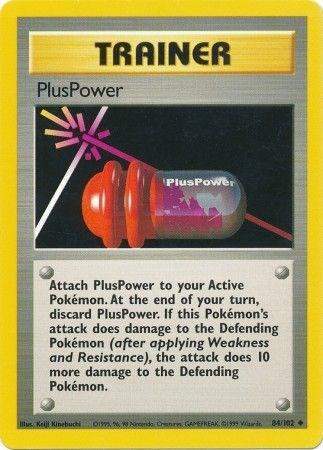 Click to enlarge
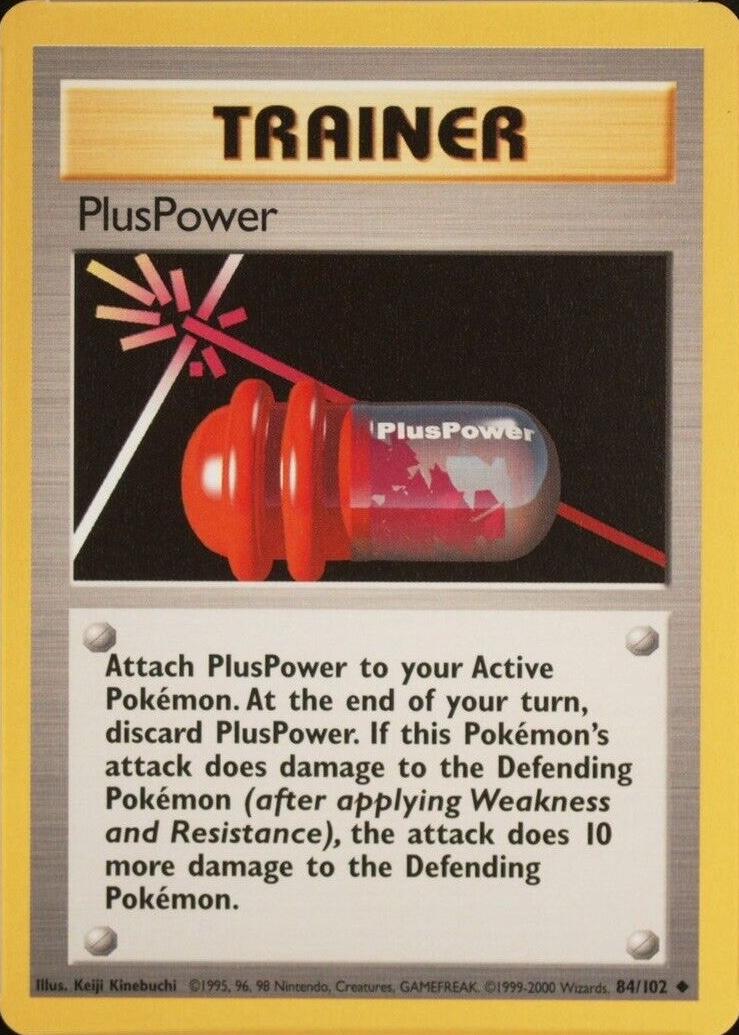 Click to enlarge
PSA 8 prices from PriceCharting sold-comp data, September 2026. Unlimited and 4th Print look nearly identical — the copyright year is the difference. Each printing is its own card with its own price and history; see every printing: 1st Edition · Shadowless · Unlimited · 4th Print.
About This Card and Set
PlusPower 84/102 is one of the quiet workhorse Trainers of the 1999 Base Set, and its story begins with a naming mix-up. In Japan the card is プラスパワー — PlusPower — which is the Japanese name of the X Attack, the in-game battle item that raises a Pokémon's Attack. When Wizards of the Coast localised the set for English, the translated name stuck: the card kept the Japanese item's title instead of the English one, and the artwork itself has 'PlusPower' inscribed on the object, which may explain why the mismatch survived.
The card was drawn by Keiji Kinebuchi, the 3D illustrator who rendered most early Trainer cards and every original Basic Energy using LightWave, giving the first sets their distinctive simple-shape look. PlusPower appeared in the Base Set, then returned in Base Set 2 (113/130) with the same art. Later prints changed both its type and wording: Diamond & Pearl reworked the effect timing, Unleashed reset the target wording before an errata reverted it, and Black & White finally printed it as an Item outright. An early prototype of the card shows it once read simply 'Increases Attack Power.'
How Rare Is This Card?
Start with the number that describes the whole card: roughly 1,111 graded copies exist in total, and ~190 of those are PSA 10s. That is a gem rate of about 17.1% — and the gem rate, not the raw population, is what a collector should actually be reading. High-grade supply is what the market pays for.
| Card | PSA 10s | Total graded | Gem rate |
|---|---|---|---|
| PlusPower 1st Edition (1999) | ~190 | ~1,111 | ~17.1% |
| Charizard ex #199, S&V 151 (2023) | 29,679 | 102,490 | ~29% |
PriceCharting population data, September 2026. The modern row is a combined PSA + CGC count; the 1999 row is PSA, the way it is normally quoted.
PlusPower was printed in enormous numbers, and its gem rate is the tightest of this batch: only about one in six graded 1st Edition copies reaches PSA 10.
That gap between a cheap raw card and a demanding gem is the whole reason the card is worth a second look.For scale, a comparable modern chase card converts to a gem grade at roughly 29%. Modern cards grade far better than vintage ones — not because they are better cards, but because a 1999 card was printed before grading was mainstream and then spent two decades in a binder.
Source: the PSA-only figures behind the Cards Worth Chasing ranking, September 2026. Two caveats stay attached to every population figure on this site. Graded counts are submission tallies, not unique cards — resubmissions inflate the total. And the census is a floor, not a final number.
Known Error Cards
PlusPower 84/102 does not appear on any of the four major English error references — Bulbapedia's Error cards page, PSA's Pokémon Error Guide, PokeBeach's misprint database, or Elite Fourum's Base Set misprint guides — so no card-specific misprint is documented for it in any printing, 1st Edition included.
What does apply is a set-wide quirk rather than a PlusPower fault: on 1st Edition Base Set cards, the 'Edition 1' stamp itself can print bold, faint, smeared, or even doubled in impression, a variation Elite Fourum documents across the 1st Edition run. Collectors treat stamp quality as part of a copy's condition, not as an error premium. The famous Base Set errors that do exist — the Unlimited Blastoise stage error, the Shadowless No Damage Ninetales, the Unlimited Wartortle evolution-box misprint — belong to other cards and other printings, so do not expect one hiding on a PlusPower.
What Makes This Card Collectible?
PlusPower rewards the collector who cares about the small print of 1999 rather than raw flash.
- Stamped or not. The 'Edition 1' mark is the entire premium — the same card without it is Shadowless, and from there Unlimited, so know exactly which print you are holding.
- Name oddity. This is an English card carrying the Japanese name of the X Attack item, a translation quirk worth explaining to anyone who asks.
- Common in 1st Edition, scarce in gem. PlusPower is an easy pull, yet PSA grades only around 190 of 1,116 1st Edition submissions a 10 — barely one in six.
A modest card with a genuine origin story — the kind of Base Set page that gets more interesting the closer you look.
The Artist: Keiji Kinebuchi
Keiji Kinebuchi is one of the illustrators who defined the look of the original English Pokémon TCG, and PlusPower is one of their Base Set contributions. This section will carry their full numbers when the artist guide lands.
Caleb's Collector Verdict
PlusPower is the Base Set Trainer that proves a plain, heavily printed card can still carry a real story worth collecting.
People Also Ask
Is my 1st Edition PlusPower real or fake?
The 1999 Base Set cards are the most counterfeited in the hobby, and for a raw copy worth real money you cannot settle it from a photo. The checks that catch most fakes: the light test (a genuine card is essentially opaque — a faint dark core line between the layers; cheap fakes glow through), the stamp rule (a real 1st Edition stamp is crisp and sits under the ink, and counterfeiters add stamps to Unlimited cards — read it with the drop shadow and the 1995-99 copyright line, never alone), and the back (fakes perfect the front and neglect the Poké Ball, the blue tone and the repeated text). Above a few hundred dollars, a raw copy should get professional pre-authentication. The full fake-detection walkthrough covers all of it.
Should I grade this card?
Not usually. A raw near-mint 1st Edition PlusPower runs about $16, and only roughly 190 of the 1,116 1st Edition copies PSA has graded reached a 10 — about a one-in-six gem rate. Sending a single raw copy in wastes money unless it looks flawless and you are already grading a batch.