
Impostor Professor Oak 1st Edition Base Set: Spelled Wrong
Reviewed by Caleb Stapel · Collector · Updated September 2026
Impostor Professor Oak is the rare Base Set card that invented a villain nobody ever explained. He debuts here as a masked man in Professor Oak’s lab coat, then returns on Imposter Oak’s Revenge and Impostor Professor Oak’s Invention without ever getting a proper story. A leftover sprite in the Spaceworld 1997 demo hints he was planned for Gold and Silver before being cut.
This page covers the 1st Edition printing specifically — the stamped, shadowless-stock version from the original January 1999 run. If you are unsure which of the Base Set Impostor Professor Oak printings you own, the 3-second test below settles it before you read any further.
No PSA population census is published for this card, so its ladder is shown in the rarity section below rather than as grade shares. Comps move — verify current sold prices before transacting.
Live Now on eBay: 1st Edition Impostor Professor Oak
What the card is actually being offered for right now. Every listing below is filtered to the genuine 1st Edition card — no repacks, mystery slabs, card skins, or multi-card lots. These are asking prices, not sold comps, so treat them as the top of the market rather than what copies are changing hands for. Buying through these links supports the site at no extra cost to you.
Loading current listings…
Which One Do You Have? The 3-Second Test
Most people who say “I have a 1st Edition Impostor Professor Oak” don’t. Retail packs in 1999–2000 were overwhelmingly Unlimited printing — and that’s fine, it’s the same iconic card. The fast check, in order:
- Right edge of the art box: a dark drop shadow = Unlimited or 4th Print. No shadow = keep going.
- Left of the art box: a black “Edition 1” stamp = 1st Edition. No stamp + no shadow = Shadowless.
- Bottom copyright line: ©1999-2000 = 4th Print. The font weight is the tiebreaker — thin text means an early print.
Impostor Professor Oak is an Trainer, illustrated by Ken Sugimori. In a raw copy, read the name line first: a true 1st Edition must say “Impostor Professor Oak” and carry the black “Edition 1” stamp beside the artwork.
The four printings of Base Set each have their own price and history: 1st Edition · Shadowless · Unlimited · 4th Print.
Click to enlarge
 Click to enlarge
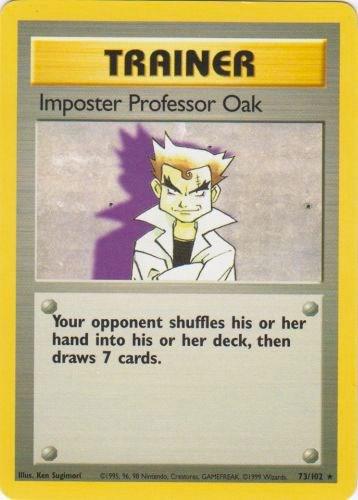 Click to enlarge
 Click to enlarge
PSA 8 prices from PriceCharting sold-comp data, September 2026. Unlimited and 4th Print look nearly identical — the copyright year is the difference. Each printing is its own card with its own price and history; see every printing: 1st Edition · Shadowless · Unlimited · 4th Print.
About This Card and Set
Impostor Professor Oak is the Base Set card that invented a villain nobody ever explained. He debuts here as a masked man wearing Professor Oak’s lab coat, and he never received a proper story in the games or the anime. He returned on Team Rocket’s Imposter Oak’s Revenge and Neo Destiny’s Impostor Professor Oak’s Invention, and a leftover sprite in the Spaceworld 1997 demo suggests he was planned for Gold and Silver before being cut. For many 1999 players he was simply the creepiest Trainer in the binder.
The card exists in four English Base Set printings: 1st Edition, Shadowless, Unlimited and the 1999-2000 fourth print. Its name is the tell. The 1st Edition and Shadowless runs read “Impostor”; every later run, including the Base Set 2 reprint, switches to “Imposter.” Wizards quietly corrected the word and never looked back. For the 25th anniversary the Imposter-spelled card was reissued in Celebrations’ Classic Collection as a Confetti Holofoil.
The character’s origins reach past cardboard. James disguises himself as Oak in the anime episodes “Will the Real Oak Please Stand Up?” and “A Faux Oak Finish!,” and in Pokémon Adventures Sabrina’s Kadabra transforms into a fake Oak in the story Kalling Kadabra. Ken Sugimori illustrated this card as Professor Oak’s mirror image, and its effect is deliberately the inverse of the genuine Professor Oak card.
How Rare Is This Card?
This is the one Base Set card with no published population census at all: PriceCharting sells-price data exists at every grade, but neither PSA nor CGC reports a count for it, which is why the site's Cards Worth Chasing ranking — built from PSA population — leaves it out. Read it as a price ladder rather than a scarcity chart.
| Grade | Market price | Census |
|---|---|---|
| Ungraded (raw NM) | — | — |
| PSA 7 | ~$44 | not published |
| PSA 8 | ~$55 | not published |
| PSA 9 | ~$176 | not published |
| PSA 10 | ~$944 | not published |
None of that makes the card scarce. It is a non-holo Rare Trainer with a deep surviving population; what makes it interesting is documentary, not statistical — the 1st Edition carries the ‘Impostor’ spelling that every later printing quietly corrected.
Source: PriceCharting sold-comp data, September 2026. No PSA or CGC census is published for this card, so the table above shows its price ladder rather than a population split — and the site's Cards Worth Chasing ranking, which is built from PSA population, does not include it.
Known Error Cards
The card’s claim to fame is a spelling error, and it is a 1st Edition error rather than an Unlimited one. Bulbapedia’s Error cards page records that the 1st Edition and Shadowless versions read “Impostor Professor Oak” instead of “Imposter Professor Oak”; the spelling flipped to “Imposter” from the Unlimited print onward, including the 1999-2000 fourth print and the Base Set 2 reprint. Because the change landed between printings, it is a name variation rather than an in-run correction. Collectors on Elite Fourum’s “Imposter vs Impostor” thread checked their holdings and found no overlap between the two spellings. PSA’s Pokémon Error Guide does not list this card, and Elite Fourum’s Unlimited-only error thread omits it too, since the “Impostor” spelling belongs to the earlier 1st Edition and Shadowless runs.
What Makes This Card Collectible?
The 1st Edition is where the “Impostor” spelling lives, so the card works as both a character and a documented misprint.
- Spelling variant. Only the 1st Edition and Shadowless runs carry the “Impostor” spelling, making the word itself the headline.
- Two printings, one card. Pair a 1st Edition with an Unlimited “Imposter” copy and the quiet correction sits side by side in a binder.
- Villain without an origin. He was cut from Gold and Silver, leaving collectors to assemble his story from just three cards.
It is one of the few Base Set Trainers whose lore is still being pieced together, which keeps the card interesting well past its rarity.
The Artist: Ken Sugimori
Ken Sugimori is one of the illustrators who defined the look of the original English Pokémon TCG, and Impostor Professor Oak is one of their Base Set contributions. This section will carry their full numbers when the artist guide lands.
Caleb's Collector Verdict
A character the franchise forgot and a name Wizards quietly fixed, both sitting on one 1st Edition Trainer.
People Also Ask
Is my 1st Edition Impostor Professor Oak real or fake?
The 1999 Base Set cards are the most counterfeited in the hobby, and for a raw copy worth real money you cannot settle it from a photo. The checks that catch most fakes: the light test (a genuine card is essentially opaque — a faint dark core line between the layers; cheap fakes glow through), the stamp rule (a real 1st Edition stamp is crisp and sits under the ink, and counterfeiters add stamps to Unlimited cards — read it with the drop shadow and the 1995-99 copyright line, never alone), and the back (fakes perfect the front and neglect the Poké Ball, the blue tone and the repeated text). Above a few hundred dollars, a raw copy should get professional pre-authentication. The full fake-detection walkthrough covers all of it.
Should I grade this card?
Grading mainly makes sense for genuinely high-grade copies. PSA has already graded well over a thousand 1st Edition examples, with the bulk sitting at Mint 9 or Gem Mint 10, so the real premium lives at the very top. A raw, off-center or played copy usually is not worth the submission fee; a sharp, well-centered one is.