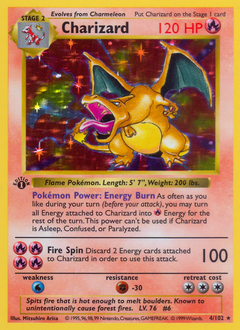
The 1999 Base Set 1st Edition Charizard is the most heavily counterfeited, most heavily graded, and most heavily written-about card in the hobby. It is also the card almost every collector eventually asks the same question about: how many of these were actually made?
Search that question and you will find a dozen confident answers. Under 10,000. Around 20,000. Maybe 100,000. A few say "millions." Almost none of them show where the number came from, and none of them agree with each other — which is the tell. A genuine estimate should converge, or at least explain its disagreements. These do neither.
This guide does it the slow way. We start from what is actually documented, work outward, and show every assumption on the page so you can push back on it.
Why There Is No Official Number
Wizards of the Coast disclosed print-run figures for Magic: The Gathering in exactly one year — 1993 — and then went silent. It never opened its books on the Pokémon line at all, in any year.
We checked the trade press of the era: 1999 runs of Scrye, Beckett Pokémon Collector, InQuest, and Wizard. Not one of them published a Pokémon print-run quantity. What the era offers instead is sales claims and scale signals, which carry no per-card numbers.
That means the answer to "how many?" is necessarily a reconstruction from evidence, not a lookup. The honest job is to make that reconstruction as transparent as possible — which is what the rest of this page does. It is also why we do not simply repeat the numbers other guides use.
The Window That Bounds the Ceiling
The single most important fact for this estimate is that 1st Edition had a short life. The stamp was added, printed for a brief window, and then dropped — and once it was gone, every card printed after that moment was by definition not 1st Edition. That transition is the hard ceiling on the entire population.
| Date | What Happened | Why It Matters to the Count |
|---|---|---|
| Nov 1998 | Earliest 1st Edition holo sheets printed (thick-stamp variant) | Earliest possible boundary of the run |
| Jan 9, 1999 | Base Set launches; 1st Edition hits shelves in North America | The market start — and the beginning of the sales figures we can cite |
| Jan 1999 | Second 1st Edition holo run (thin-stamp) plus the Shadowless run | The stamp was still being applied |
| Feb 1999 | Shadowless → Unlimited transition; the drop shadow returns | This is the 1st Edition cut-off. Nothing after it can be 1st Edition |
| Mar–Apr 1999 | Full retail availability; demand explodes | Unlimited volume ramps here — the source of the inflated "10M pack" figure |
| Jun 16, 1999 | Jungle launches, pushed up from August | Base Set printing continues, but as Unlimited |
| Feb 2000 | The [1999–2000] copyright run (UK / GPS) | The final Base Set print — still not 1st Edition |
So the entire 1st Edition population came out of a window of roughly January 9 through early March 1999 — about two months, bounded on the far side by Jungle’s 16 June release, which had to follow Shadowless and the start of the Unlimited run. That is the ceiling. Whatever number you land on has to fit inside that window.
One correction we owe our own earlier work: this page used to say the stamped run lasted “about six weeks.” That figure is a sales window, not a print window — Kotaku’s line is that Wizards sold 400,000 packs “in the property’s first six weeks on sale.” The print run itself was about two months. Four to six weeks belongs to Shadowless, the transitional run that followed.
We do have contemporaneous sales reporting for that window, and it is useful context — but it is sales, not production, and it is not what this estimate is built on. Wizards was publicly reporting its own launch numbers at the time: roughly 400,000 packs sold in the first six weeks on sale, and by 6 April 1999 Anime News Network had Wizards at about 600,000 units in eight weeks, backlogged with orders. Note the unit switch in that second figure — “units” includes the 2-Player Starter Sets, of which Wizards had already moved over a million. Kotaku's later reporting notes the launch ran at roughly ten times what Wizards had projected internally, and the New York Times reported in April 1999 that Wizards was rationing shipments. All of this describes demand outrunning supply, which is exactly why the run was small — but none of it tells us how many packs were printed, so we do not use it as an anchor.
Who Actually Printed Them — and Why It Was Slow
A print run is not just a number; it is a physical process with a throughput. If you can trace how the cards were made, you can sanity-check any estimate against what the factories could plausibly have put out in the time available. For 1st Edition Base Set, that chain has been traced sheet by sheet.
The short version: 1st Edition Base Set was not one factory. It was a serial three-shop relay. Card backs and non-holo faces were printed at PBM Graphics in North Carolina. Those sheets were then shipped to UV Color, which had the UV-capable presses required for holographic foil, to laminate and print the holo faces. Finally the completed sheets went to Wrap-It Corp in South Dakota to be cut and packed.
| Stage | Facility | What They Did |
|---|---|---|
| 1. Backs & non-holo faces | PBM Graphics — Research Triangle Park, NC | Printed card backs (documented 1/21/99) and the non-holo card faces. PBM was the anchor printer and would become the world's largest Pokémon card producer. |
| 2. Holo faces | UV Color | Laminated and printed the holographic faces. Chosen for UV-capable presses, sports-card experience, and security — and every holo card passed through here, including every Charizard. |
| 3. Cut & pack | Wrap-It Corp — Howard, SD | Slit, cut, collated, and packaged the finished sheets into boosters, decks, and boxes. |
PBM's own history confirms the vertical logic behind it: PBM printed both Magic and Pokémon, and the collectible-card boom is precisely why PBM acquired Wrap-It. Its presses were only partly UV-capable — by one account just 8 of its 11 presses were — which is exactly why the holo work had to be handed off to UV Color rather than done in-house.
The Sibling Factory, for Completeness
A second US plant mirrored the same pattern. Yaquinto printed backs and non-holo faces in Texas, but still shipped its holo sheets to UV Color and had the finished product cut and packed elsewhere. Non-English 1st Edition (French and German) was printed at Carta Mundi in Belgium, which later developed its own UV capability.
The Magic: The Gathering Check — and Why It Is a Ceiling, Not a Floor
Magic: The Gathering is the only trading card game of that era with factory-confirmed print-run numbers. They come from the Carta Mundi archive, released in 2021, and they give us the actual scale at which Wizards operated — at the same company, five years earlier, on the same kind of product.
| Magic Edition | Total Cards Printed | Copies of Each Rare | What It Maps To |
|---|---|---|---|
| Alpha (1993) | 2,609,728 | 1,008 | The "1st Edition" analog — the deliberately short first run |
| Beta (1993) | 7,830,515 | 3,025 | Corrected reprint of the same set |
| Unlimited (1993) | 35–40,000,000 | ~18,500 | The mass-market run |
| Revised (1994–95) | ~150–600,000,000 | ~289,000 | Peak run |
That structure lines up almost exactly with Pokémon. Magic's first run, Alpha, was capped by Wizards' founder as a deliberate short print to keep the game collectible — the same instinct behind a stamped 1st Edition run. Alpha → Beta → Unlimited maps one-to-one onto 1st Edition → Shadowless → Unlimited.
Here is the part that matters for the count, and it is the part most other guides get backwards. Magic's Unlimited run of roughly 35–40 million cards went through one integrated plant doing backs, faces, and cutting in a single flow. Pokémon's holo production added an entire extra facility leg plus shipping between three shops, and every single holo was bottlenecked at that middle step.
So Pokémon's 1st Edition run was structurally slower per unit than Magic's single-plant operation. That makes Magic's throughput a ceiling for Pokémon, not a baseline to build up from — which is exactly why our estimate leans toward the low end of its range rather than the high end.
A Primary Source on the Constraint
Carol Monahan, Wizards of the Coast's Director of Sales and Logistics from 1993 to 2000, has confirmed that capacity was still a live constraint in 1999: "there were still constraints of capacity, both in terms of getting press and assembly time, and securing enough appropriate cardstock." She also noted the company rented 17 refrigerated semi trailers in the summer of 1999 purely to hold Pokémon product volume.
On Shadowless specifically, her account is the honest one the whole hobby should adopt: Wizards "simply updated the files at the printer as soon as they were able... No one has official numbers on how big that run wound up being."
The Floor: What the Graded Census Actually Says
The only hard census data that exists for this card is the graded population — and the first thing to get right is what that number actually represents.
Across PSA, BGS, CGC, and SGC, total submissions-ever for a 1st Edition Charizard sit at roughly 6,800. But that is a submission tally, not a count of unique physical cards. Crack-and-regrade inflates it: a card cracked out and resubmitted gets a new cert and adds a new pop-report line, and the old grade is not retired. Following collector convention for a high-value vintage card, we model that at a modest ~10%, which leaves roughly 6,100 unique graded cards.
| Grader | Submissions | Notes |
|---|---|---|
| PSA | ~5,467–5,567 | Largest share; about 124 PSA 10s, a gem rate near 2.3% |
| BGS | ~1,129 | 405 thick-stamp and 724 thin-stamp; the weakest data point, dated Dec 2024 |
| CGC | ~502–589 | Varies by source (OG Cards vs. PriceCharting) |
| SGC | 47 | Negligible for this card |
Putting the Range Together
Three independent inputs, each doing a different job. The window bounds the ceiling. The factory chain tells us to lean low within it. The census sets the floor. Then one arithmetic step converts packs to a specific card.
Step 1: Packs to Cards
This is the step that runs in reverse here. We do not start from a pack count and divide down; we start from the Charizards that exist and multiply up. Roughly 6,120 unique graded copies, each one implying 45 packs, gives a floor of ≥275,000 packs opened. Adding the copies that were never graded and the product that stayed sealed brings the printed total to ~275,000–550,000 packs, centred around 400,000. There is no need to estimate total card volume at all — the pack figure falls straight out of the census.
Step 2: Cards to Charizards
Holos appeared in roughly 1 in 3 packs. The booster holo pool was 15 cards, not 16 — Machamp #8 was a 2-Player Starter exclusive and never appeared in booster packs at all. So a specific pack-pullable holo lands at roughly 1 in 45 packs: the 1-in-3 holo rate spread across the 15-card pool.
The floor: the minimum number of packs that must have been opened for that many Charizards to be sitting in slabs today.
Then add back what has not been counted — copies never submitted, and packs still sealed:
| Assumption | Packs Opened | Packs Printed |
|---|---|---|
| Floor — every pulled Charizard graded, no sealed product | ≥275,000 | ≥275,000 |
| 70% of pulled copies graded, ~5% still sealed | ~393,000 | ~414,000 |
| 70% graded, ~9% sealed | ~393,000 | ~432,000 |
| 55% graded, ~9% sealed | ~501,000 | ~551,000 |
Read down the column: the floor is arithmetic, and everything above it is a labelled assumption about how much of the run survived ungraded or unopened.
One assumption is labelled because it is an assumption: this treats the 15 pack-pullable holos as roughly evenly distributed. The actual collation was not a perfectly clean independent roll, so treat ~1-in-45 as an approximation rather than a precise figure. It is, however, the most defensible conversion available, and it is far more grounded than the flat per-card guesses elsewhere.
The Capture Check — Why the Range Holds Together
An estimate is only credible if a second, independent constraint agrees with it. Here the census provides one, because it tells us what fraction of the pulled Charizards have been graded — and that fraction has to be believable.
| If the Pack Total Were… | Charizards Pulled | Graded Capture Rate | Does It Make Sense? |
|---|---|---|---|
| ~275,000 (the floor) | ~6,120 | ~100% | No as a literal reading — but it is the floor precisely because it assumes every pulled copy was graded and none stayed sealed. The real number is above it. |
| ~400,000 (centre) | ~8,900 | ~69% | Yes. High, but this is the most-graded vintage card in the hobby and it was valuable from day one. |
| ~551,000 (upper) | ~12,200 | ~50% | Yes — requires half of all pulled copies to have been graded, which is plausible for this card. |
| 2.7 million (the “75,000 boxes” claim) | ~60,000 | Under 10% | No. It demands that fewer than 1 in 9 Charizards was ever graded — impossible for the most-submitted vintage card there is. |
The roughly 69% capture rate at the 400,000-pack centre deserves a word, because it is the assumption most likely to be challenged. A capture rate that high sounds implausible for a 27-year-old card — and it would be, for almost any other card. It is defensible here for these specific reasons:
- It was valuable immediately. Charizard was the most wanted card in the game from the day it released. People did not treat it as disposable at the time; they protected the ones they had.
- The window was short and it stayed iconic. The card was only openable for a matter of months, so a huge share of the population was never subjected to years of casual handling the way later Unlimited stock was.
- Barely any genuine raw supply moves. When you look at the raw market, listings are overwhelmingly flooded with counterfeits and metal replicas. Real raw copies rarely surface, which is consistent with grading having absorbed much of the recognizable supply over the last decade.
- And the floor does not depend on any of that. Even if the capture rate were far lower than we assume, the 275,000-pack floor still holds, because it is built from cards that have already been graded. The assumptions only move the upper end.
Where the Rest Went
At ~275,000–550,000 packs printed and ~275,000 opened at the floor, the sealed share of the run is small: auction-house estimates put surviving sealed boxes in the few-hundred-to-1,000 range, which against a run this size is roughly 3% to 9% of packs still sealed. The rest were opened — and of the Charizards pulled, roughly 6,120 are now graded. The high preservation share is the direct consequence of the card being a known grail from day one: it was curated and slabbed, not casually discarded the way ordinary cards were.
Where Everyone Else’s Numbers Come From — and What Is Wrong With Them
If you have read other estimates and wondered why they are so far off, this is the section that answers it. None of the popular figures are deliberate misinformation. They are reconstructed guesses that hardened into internet fact, and there is a documented case study of exactly how that happens.
| Figure You Will See | Where It Comes From | The Problem With It |
|---|---|---|
| "Under 10,000 of each card" | PSA's own 2016 Set Registry article, which explicitly framed it as an estimate | It was never a record — and it applies a single number across every rarity in the set, holos and commons alike |
| "~10 million 1st Edition packs" | Hobby circulation, repeated widely | The most damaging one. It spans the entire 1999 printing year, including the huge Unlimited ramp after March. 1st Edition was about two months |
| "Specified ~1 in 48 packs" | Forum arithmetic repeated across sites | Close to our ~1-in-45, but typically presented without stating the 15-card pool or the 1-in-3 holo rate behind it |
| "75,000 booster boxes" | A site asserting a box count with no sourcing | Killed by arithmetic. 75,000 boxes = 2.7M packs = ~60,000 Charizards, against under 7,000 ever submitted — it needs fewer than 1 in 9 to have been graded, on the most-submitted vintage card in the hobby. The claim's own figures only reconcile near ~6,250 boxes. |
| "100,000 to 340,000 Charizards" | Forum models scaling from Magic's peak volumes | Ignores the two-month window and the serial factory bottleneck entirely |
| "~20,000–22,000" | Derived from an assumed ~500–600K pack count | Closest to defensible — but usually shown without the assumptions or the factory constraint |
The D'Angelo Lesson, Which Is the Whole Point
In 1996, Stephen D'Angelo reconstructed Magic: The Gathering's print numbers and flagged them honestly as "guesses based on almost no information... no inside information." Within a year they were being repeated across the internet as fact. When the Carta Mundi archives finally confirmed the real numbers in 2021, his estimates turned out to be directionally right but off — he put Alpha's rare count at 1,100; it was actually 1,008.
That is exactly what has happened to every Charizard print-run number in circulation. A reasonable guess is published with caveats, the caveats fall off in repetition, and within a year the guess is a citation. It is why this page shows its work and states its assumptions instead of leading with a confident figure.
Frequently Asked Questions
How many 1st Edition Base Set booster packs were printed?
Roughly 275,000 to 550,000, centred around 400,000. No official number exists — Wizards of the Coast never published Pokémon production quantities. The estimate is built backward from the graded census: roughly 6,120 unique graded 1st Edition Charizards, each implying 45 packs, which sets a floor of at least 275,000 packs opened. The upper end adds copies that were never submitted and sealed product that survived.
Why do other sites say a much higher number?
Most anchor to a roughly 10 million 1st Edition pack figure circulating in the hobby. That spans the entire 1999 printing year, including the Unlimited ramp after March — 1st Edition was a roughly two-month product. Separately, the widely repeated 400,000–600,000 anchor mixed units: the 600,000 counted units, not packs, and swept in 2-Player Starter Sets. Neither figure is used on this page.
Did Wizards of the Coast ever release the print run?
No. Wizards published Magic: The Gathering print-run quantities in exactly one year, 1993, and then went silent — and never opened its books on Pokémon in any year. The Pokémon Company International has reportedly said it does not hold the Wizards-era production records. Anyone quoting an exact Charizard number is repeating a reconstruction, not a record.
How many 1st Edition Charizards have been graded?
About 6,800 submissions across PSA, BGS, CGC, and SGC — but that is a submission tally, not unique cards, because crack-and-regrade adds lines without adding cards. Allowing ~10% leaves roughly 6,120 unique graded copies. Only about 124 have earned a PSA 10, a gem rate near 2.3%.
How long was the 1st Edition print run?
About two months — the 9 January 1999 launch into early March, bounded on the far side by Jungle’s 16 June release, which had to follow Shadowless and the start of Unlimited. The often-quoted “six weeks” is a sales window (400,000 packs sold in the first six weeks on sale), not a print window. Four to six weeks is the correct figure for Shadowless, the transitional run that followed.
Could “75,000 booster boxes” be right?
No — it fails arithmetic. 75,000 boxes is 2.7 million packs, which at 1 in 45 implies ~60,000 Charizards, against under 7,000 ever submitted to a grader. That would require fewer than 1 in 9 Charizards to have been graded, on the most-submitted vintage card in the hobby. The claim’s own numbers only reconcile near ~6,250 boxes.
So is a 1st Edition Charizard actually rare?
Yes, but for the right reason. The card is not ultra-rare in the way a misprint is. What is extraordinarily rare is a high-grade copy: only ~124 PSA 10s, a ~2.3% gem rate, because the 1999 English foil was soft and prone to micro-scratching from pack insertion, and factory blades frequently left edge silvering that capped pack-fresh cards at a PSA 8. The scarcity is in the condition, not the population. See the 1st Edition Charizard review for the grade-by-grade picture.
Next: How the Print Runs Differ
The full 1st Edition Base Set guide covers all four printings — 1st Edition, Shadowless, Unlimited, and the 1999–2000 run — including how to tell which one you actually have, the error cards worth knowing, and where the value sits.
Sources
Graded census: tcgScreener Charizard 1st Ed population (2026-07-29); PriceCharting monthly pop report; PokeInvest; OG Cards (Dec 2024); CardboardSniper Base Set Pop Report (2026-07-10); t206cards (2026-06-30); PSA CardFacts.
Magic: The Gathering print runs: Carta Mundi archive released 2021; mtgprintrun.com; Peter Adkison via Carta Mundi (Mar 2021); Deconstructing Print Runs; Crystal Keep / D'Angelo (1996) — carried as historical context, not data.
Factory & print chain: Elite Fourum “Pokémon TCG Set Credits” thread — PBM backs documented 1/21/99, UV Color holo fronts, Wrap-It cutting and packing, Carta Mundi Belgium for French and German; pokemuseum uncut-sheets print-run table; PBM / News & Observer “Gotta print 'em all” (2025); PI World “PBM Graphics — True to Their Heritage” (2006).
Wizards capacity & launch: Carol Monahan (Wizards Director of Sales & Logistics, 1993–2000); Anime News Network (1999-04-06); Kotaku on the Wizards era; New York Times (Apr 1999, rationing); Washington Post (Aug 1999).
Timeline & variants: Bulbapedia Base Set; PSA Set Registry; Beckett; CardTrack; PokeMasters.